-
 Hakuza gold leaf Natsume
Towa-iro -
 Hakuza gold leaf Natsume
Towa-iro -
 Hakuza gold leaf Natsume
Kuon-iro -
 Hakuza gold leaf Natsume
Kuon-iro


Hakuza Gold Leaf Hira Natsume
Gold Leaf Hira Natsume
Couldn't load pickup availability
24K Gold & Platinum Leaf · Yamanaka Lacquerware, Ishikawa
Two Shades of Gold, Each with Its Own Warmth
The "Sensuji" natsume is finished in one of two golds developed by Hakuza. Towa-iro (99% gold, 1% platinum) sits close to the color of pure gold, with a trace of platinum bringing a deeper, more dignified richness to its glow. Kuon-iro (92% gold, 8% platinum) leans toward champagne, its brightness softened by a smoky undertone — a quieter kind of shine.
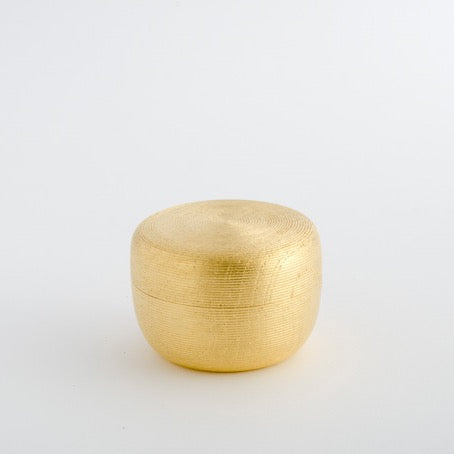
Towa-iro finish
The Yamanaka Technique Behind the Fine Lines
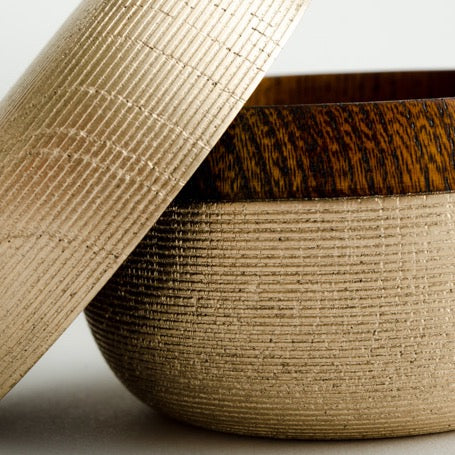
In Yamanaka Onsen, Ishikawa — a region known for centuries of woodturning — artisans carve a series of fine grooves into each vessel on a lathe, a decorative technique called sensuji. Sheets of soft gold leaf are then pressed by hand into these grooves, one at a time, so the surface catches and shifts light differently depending on the angle it's viewed from. Inside, the natural grain of keyaki (Japanese zelkova) is left visible under a fuki-urushi lacquer finish, giving the piece warmth wherever the gold isn't.
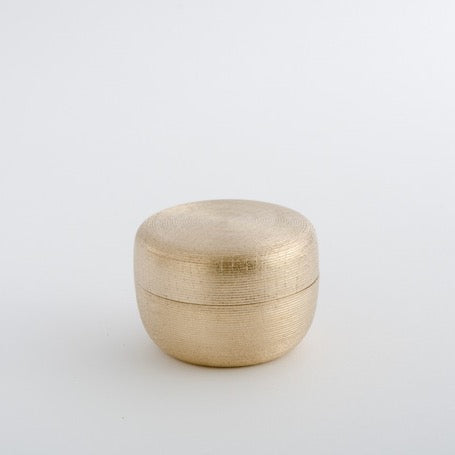
Kuon-iro finish
Kanazawa: The Gold Leaf Tradition Behind Hakuza
Hakuza's workshop is based in Kanazawa, a city that has produced over 99% of Japan's gold leaf for more than 400 years. Turning a piece of gold alloy roughly the size of a coin into a sheet as large as a tatami mat — without dulling its shine — takes years to master. Among the techniques passed down in Kanazawa is entsuke kinpaku, recognized by UNESCO as an Intangible Cultural Heritage in 2020. Rather than simply stretching the gold thinner, artisans press it between sheets of handmade gampi paper that has been treated with straw ash lye, persimmon tannin, and egg white, then beaten for six months to prepare it. The goal is to transfer the paper's own fiber structure onto the foil's surface — a texture that scatters light instead of reflecting it flatly, giving the gold a softer, more layered depth than foil pressed on plain paper. It's this craft that shapes every piece Hakuza makes.
From Tea Ceremony to Everyday Treasure
A natsume is traditionally a container for matcha, used in the Japanese tea ceremony. Its quiet, composed form also suits a second life — as a case for rings, cufflinks, or other small objects worth keeping somewhere beautiful. Either way, it makes a considered gift for someone who notices craftsmanship.
Specifications
H 2.4 in × Diameter 3.3 in (60 × 85 mm)
Towa-iro: Gold-platinum leaf (99% gold, 1% platinum), Japanese zelkova (keyaki), urushi lacquer
Kuon-iro: Gold-platinum leaf (92% gold, 8% platinum), Japanese zelkova (keyaki), urushi lacquer
Made in Japan — gold leaf from Kanazawa, lacquerware from Yamanaka, Ishikawa Prefecture
Shipping
Ships within 2 weeks · Shipping cost included in price
Care
Not for use in the microwave, oven, refrigerator, or dishwasher. Avoid scouring pads and abrasive cleaners. With handling over time the gold leaf may show slight flaking — a natural trait of hand-applied foil, not a defect. As each piece is turned from natural keyaki wood, grain pattern varies slightly piece to piece.
How to Use
Traditionally, a natsume holds matcha — the powdered green tea whisked in the Japanese tea ceremony (chanoyu). Its refined form also works well as a case for rings, cufflinks, or other small treasured objects, whether on a dresser or an entryway table.
Note
Available in two finishes — Towa-iro for a deep, radiant gold, and Kuon-iro for a softer, champagne-toned gold. Because the leaf is applied by hand, subtle variation between pieces is part of its character.
-
Hakuza gold leaf Natsume
Towa-iro -
Hakuza gold leaf Natsume
Towa-iro -
Hakuza gold leaf Natsume
Kuon-iro -
Hakuza gold leaf Natsume
Kuon-iro