-
 Gumpu Nakamura
Kutani Ware Vase "Kizuna"

Gumpu Nakamura Kutani Ware Vase "Kizuna"
Kutani Ware Vase "Kizuna"
Couldn't load pickup availability
Kutani Ware ・ Contemporary Ceramics ・ Ishikawa, Japan
A Glaze That Conceals Color Within Color
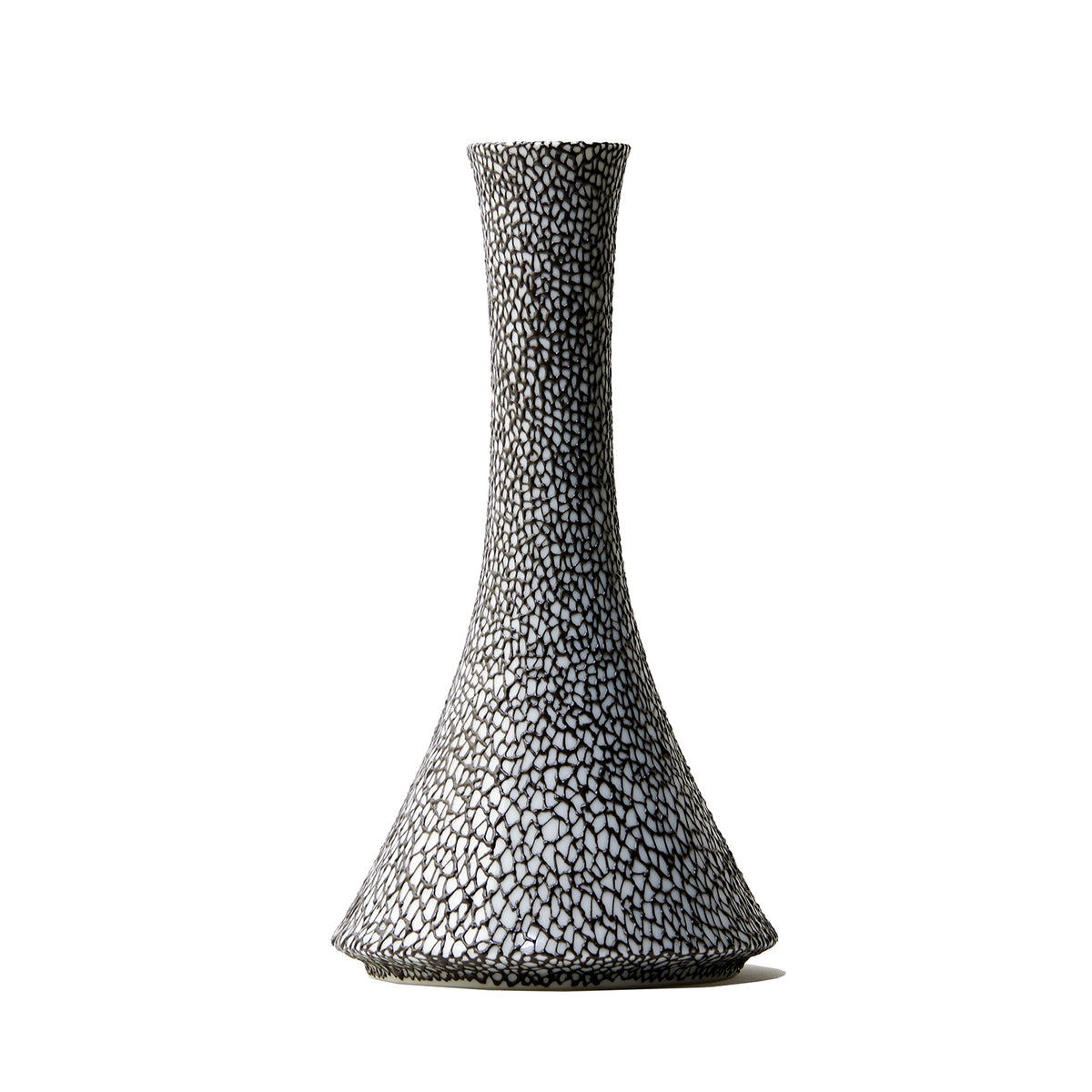
The vase reads dark at a distance — a composed, near-black brown, quiet and considered. Up close, or as the light changes, something else emerges: traces of red, yellow, green, indigo, and violet surface from within the glaze and recede again. Nakamura blends five pigments into a single glaze formulation with tolerances measured in 1/100,000th of a gram, then fires each piece in a kiln managed to within one degree of temperature. The result is a surface that does not announce itself all at once. It gives you something different the longer you look — and differently again each time the light in the room shifts.
"Ceramics is science."
— Gumpu Nakamura, ceramic artist
The Woven Pattern — Structure as Subject
Running across every surface of the vase is a lattice of interlocking lines — a pattern that reads as textile from a distance, and as precise geometry up close. Nakamura did not choose the pattern for decoration. The woven structure gives form to something harder to show: the nature of human connection, the way one line depends on what it crosses, and the way the whole holds together because of every individual intersection. Kizuna (絆) — the piece's name — translates as bond, or connection. It is not a label applied after the fact. It is the reason the pattern is there.
A Ceramic Practice Built on Scientific Precision
Nakamura's approach to Kutani ware draws from the tradition's 360-year lineage while insisting on a methodology that is, in his own description, essentially scientific. He develops his own glaze formulations, maintains consistent ratios across every batch, and manages the kiln's firing schedule with attention that most ceramicists reserve for the clay itself. The practice produces work that holds a consistent character across an edition — a degree of control unusual in hand-thrown ceramics, where the kiln's behavior is treated as a variable to be managed, not accepted. For a collector, it means the piece you receive corresponds closely to the one photographed.
Kutani Ware — A Ceramic Tradition from Ishikawa Prefecture
Kutani ware originated in the Kaga region of Ishikawa Prefecture — the area that now encompasses Kanazawa and the surrounding towns — in the mid-17th century. It is distinguished by the depth and boldness of its painted glazes, a tradition that has produced some of Japan's most formally ambitious ceramic work over nearly four centuries. Nakamura works within this lineage as a contemporary artist rather than a historical reproducer. The forms are his own, the glazes are formulations he developed, and the pattern vocabulary he uses connects to the tradition without quoting it directly. What carries forward is the underlying ambition: a surface that earns attention.
Specifications
Artist: Gumpu Nakamura
W 5.3 in × D 5.3 in × H 10.0 in (135 mm × 135 mm × 255 mm)
Material: Kutani ware (ceramic)
Glaze: Original formulation — dark brown-black base with red, yellow, green, indigo, and violet pigment blend
Shipping
Ships within 2 weeks ・ Shipping cost included in price
Care
Avoid sudden changes in temperature — do not move the piece directly from a cold to a hot environment, or place it on an extreme surface temperature. Thermal shock may cause cracking.
Hand wash only; not suitable for dishwasher use.
Do not use abrasive scrubbers or strong chemical cleaners — wipe gently with a soft, damp cloth if needed.
Handle with care. Ceramic is brittle and will chip or crack if dropped or struck.
How to Use
Designed as a vase for displaying cut flowers or branches. The form — 5.3 in wide, 10 in tall — works well with a single long-stemmed flower, a loose arrangement of three to five stems, or a few bare branches where the vessel itself is the primary subject. Dried botanicals are equally suited to the piece, and require no water or maintenance.
Place where the surface is visible at close range — on a shelf, a side table, or a mantel — so the glaze can be read in different light conditions. The color within the dark glaze shifts noticeably from morning light to evening, and from direct to ambient sources.
Note
Each vase is formed and glazed by hand. The precise distribution of color within the glaze surface will vary from piece to piece as a result of the firing process — this individual character is inherent to the work, and no two pieces are exactly alike.
Because of the handcrafted nature of this work, we are unable to accept returns or exchanges based on differences in color, texture, or glaze character from the photos shown.
Share
-
Gumpu Nakamura
Kutani Ware Vase "Kizuna"