-
 Yamato

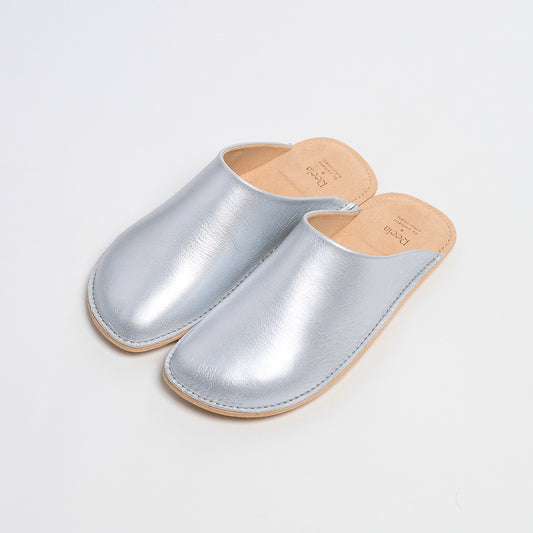
Yamato Corporation — Leather Room Sabots from Matsuyama, Ehime
Sixty Years of Sandals, One Product at a Time
Yamato Corporation has made sandals — and only sandals — since 1963. The plant in Matsuyama, Ehime Prefecture is run by a small team of craftsmen, most of them veterans with decades on the floor. There is no pivot, no adjacent product line. Just sandals, and the accumulated knowledge of making them well.

The Yamato workshop, Matsuyama
Satoshi Tanio, the company's director, describes what that accumulated effort is actually for.
"There is a Japanese idea — beauty that comes through use. I believe that kind of beauty can only exist in something people actually wear, in their actual lives. What we make is the result of removing everything that isn't necessary and keeping what is. The outcome, if we do it right, is something comfortable and beautiful at the same time."
— Satoshi Tanio, Director, Yamato Corporation
How Reela Came to Exist
Reela was not planned. It came out of a problem.
"We were invited to an interior design exhibition in 2016. Bringing our outdoor sandals felt out of place, so we decided to make something for indoors instead. But if we made ordinary slippers, we couldn't compete on cost with manufacturers built for that. So we asked: what could we make that used our technology, our know-how — that no one else was really doing? That's when we landed on genuine leather room shoes. Surprisingly rare, it turned out."
— Satoshi Tanio
The prototypes were well received at the exhibition. The concept behind Reela — "Simple & Relax" — has not changed since: footwear without pretension, built for the hours spent at home. Today, Reela is used not only in private homes but in luxury hotels, high-end ryokan, and model residences as a hospitality item for guests.
The Wooden Last
A process that cannot be rushed
Each pair of Reela is built on a wooden last — a form traditionally used in shoe production, rarely seen in sandal making. After the leather is shaped around the last, the piece must rest for several days before it can be removed. This is not negotiable. The result is a fit and profile that cannot be achieved by skipping the step.

Wooden lasts used in production
"You could make something that looks similar without using a wooden last. Most people wouldn't notice the difference immediately. But people who understand footwear can see it. We've had peers tell us: even if you tried to copy this process, you couldn't."
— Satoshi Tanio
Natural leather, cut one piece at a time
The upper is made from natural cowhide leather tanned in Japan. Unlike synthetic materials, which can be stacked and cut in multiples, natural leather must be cut one piece at a time. Each pair of Reela takes approximately a week to complete. A single production run yields only a few dozen pairs.

Hand-cutting natural leather
Yamato Corporation was founded in 1963 in Matsuyama, Ehime Prefecture. The company produces sandals and leather footwear for domestic and international markets, and has supplied OEM production to major Japanese apparel brands. Reela, their leather room sabot line, is produced entirely in Japan.
-
Yamato

Items
-
Room Shoes "Reela"
Regular price From ¥23,000 JPYRegular priceUnit price per