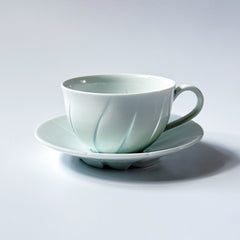

Known for its vivid colors and intricate decoration, Kutani ware has been produced in Ishikawa Prefecture for more than 360 years. By the Meiji era, it had reached an international audience and became widely known overseas as "Japan Kutani."
Yet the appeal of Kutani ware lies not only in its long history. Throughout the centuries, artists and kilns have continued to introduce new colors, techniques, and forms of expression, allowing the tradition to evolve from one generation to the next.
This article looks at the history, distinctive colors, and meanings behind the patterns of Kutani ware before introducing two contemporary artists who are carrying the tradition forward: Kazuhiko Komekyu and Gumpu Nakamura. One pursues extraordinary precision through fine brushwork; the other explores color through independently developed glazes and firing techniques. Their works reveal a ceramic tradition that is not simply being preserved, but continues to change today.
What Is Kutani Ware?
Kutani ware, or Kutani-yaki, is a Japanese ceramic tradition from Ishikawa Prefecture, known above all for its vivid colors and highly expressive overglaze decoration. Its origins date to the mid-17th century, when porcelain production began in Kutani village, in present-day Kaga City.
Sometimes described broadly as Kutani pottery, Kutani ware is not defined by one particular shape or pattern. What connects its many styles is the importance placed on decoration after the ceramic body has been glazed and fired. Pigments are applied over the glaze and fired again, allowing color and brushwork to become a central part of the finished piece.
Is Kutani Ware Pottery or Porcelain?
Kutani ware is most closely associated with Japanese porcelain. Its smooth white surface provides a particularly clear ground for vivid colors, fine painted lines, and gold decoration.
However, contemporary Kutani ware can include both porcelain and stoneware. The term therefore refers less to a single ceramic material than to a regional tradition distinguished by its approach to color and overglaze decoration.
Ko-Kutani Ware: The Beginning of Kutani
The earliest Kutani ware is known as Ko-Kutani, or Old Kutani. Production began around 1655 after porcelain stone was discovered in the Kutani area of present-day Ishikawa Prefecture.
Ko-Kutani porcelain became known for bold compositions and rich color. Two styles are particularly associated with this period: iroe, which uses the full five-color Kutani palette, and aote, which omits red and often covers much of the surface in green, yellow, purple, and deep blue.
Production at the original Kutani kiln lasted for only several decades before unexpectedly coming to an end. The reason remains uncertain, and relatively few works from the earliest period survive today.

Kutani Gosai: The Five Colors of Kutani Ware
Color is at the heart of Kutani ware.
The traditional palette known as Kutani Gosai consists of five colors: green, yellow, purple, navy blue, and red. Yet these colors do not produce one single "Kutani style."
Green, yellow, purple, and blue can form broad, richly colored areas, while red is particularly suited to delicate line work. Over generations, different kilns and artists developed distinct ways of working with the same vocabulary of color.
That diversity is one reason two pieces of Kutani ware can look entirely different while still belonging to the same tradition.
Kutani Ware Patterns and Their Meanings
The decoration of Kutani ware is not only about color. Many pieces also draw on traditional Japanese motifs, including kisshō mon'yō — auspicious patterns that have long been used to express wishes for happiness, prosperity, longevity, and good fortune.
Flowers, birds, landscapes, and geometric patterns appear throughout Kutani ware, and some motifs carry meanings that have been passed down through Japanese decorative culture.
Not every Kutani pattern has a fixed symbolic meaning. Some motifs are valued for their beauty, their connection to nature and the seasons, or the history behind the design itself.
These motifs can also take on a distinctly individual character in the hands of an artist. In Kazuhiko Komekyu's work, traditional patterns are reconstructed from extraordinarily fine lines, layering inherited meanings with the expression of the person who paints them.
Spinning Top
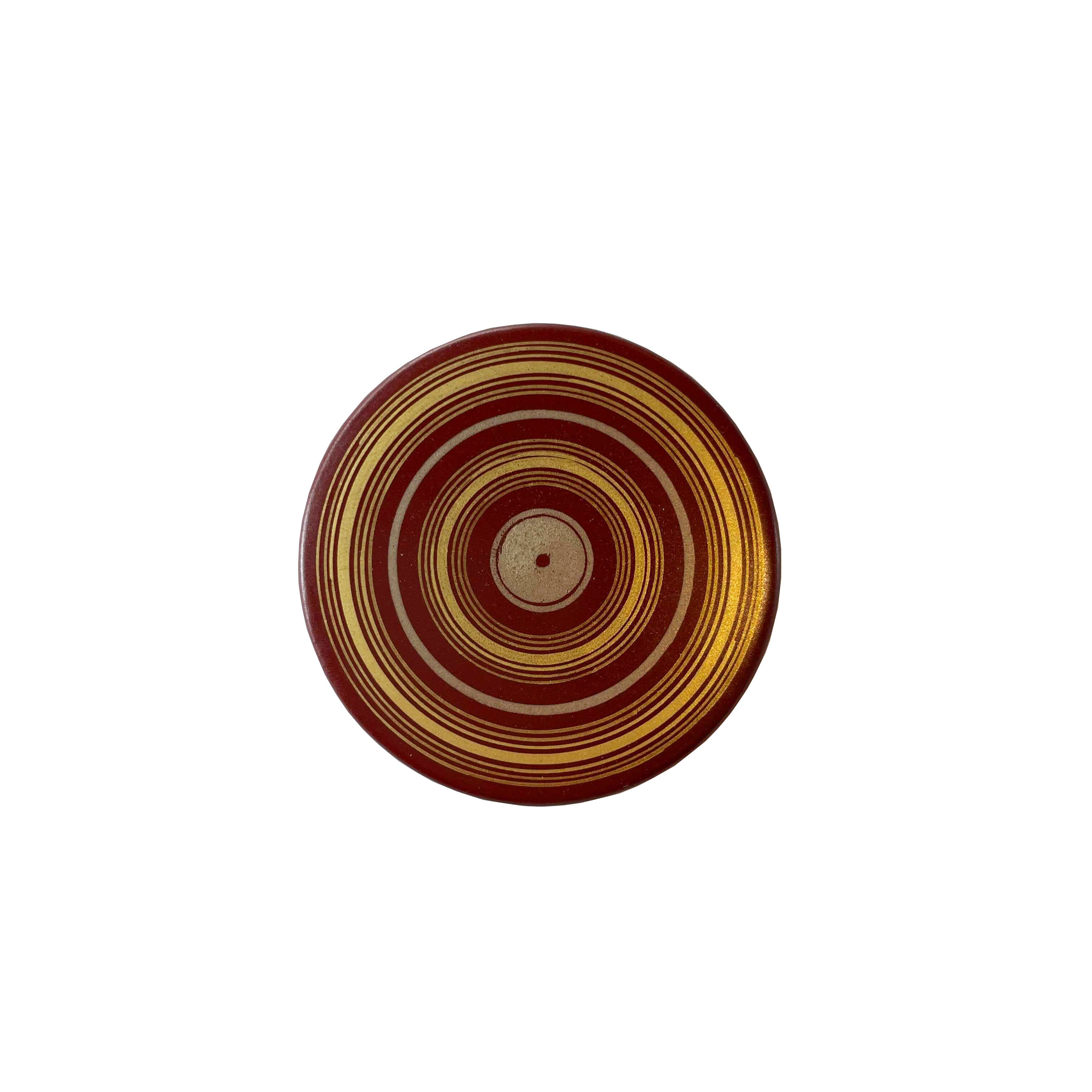
Because a spinning top continues to turn smoothly around its axis, the motif is associated with the idea of things "turning well" — a wish for good fortune to keep circulating.
Cherry Blossom
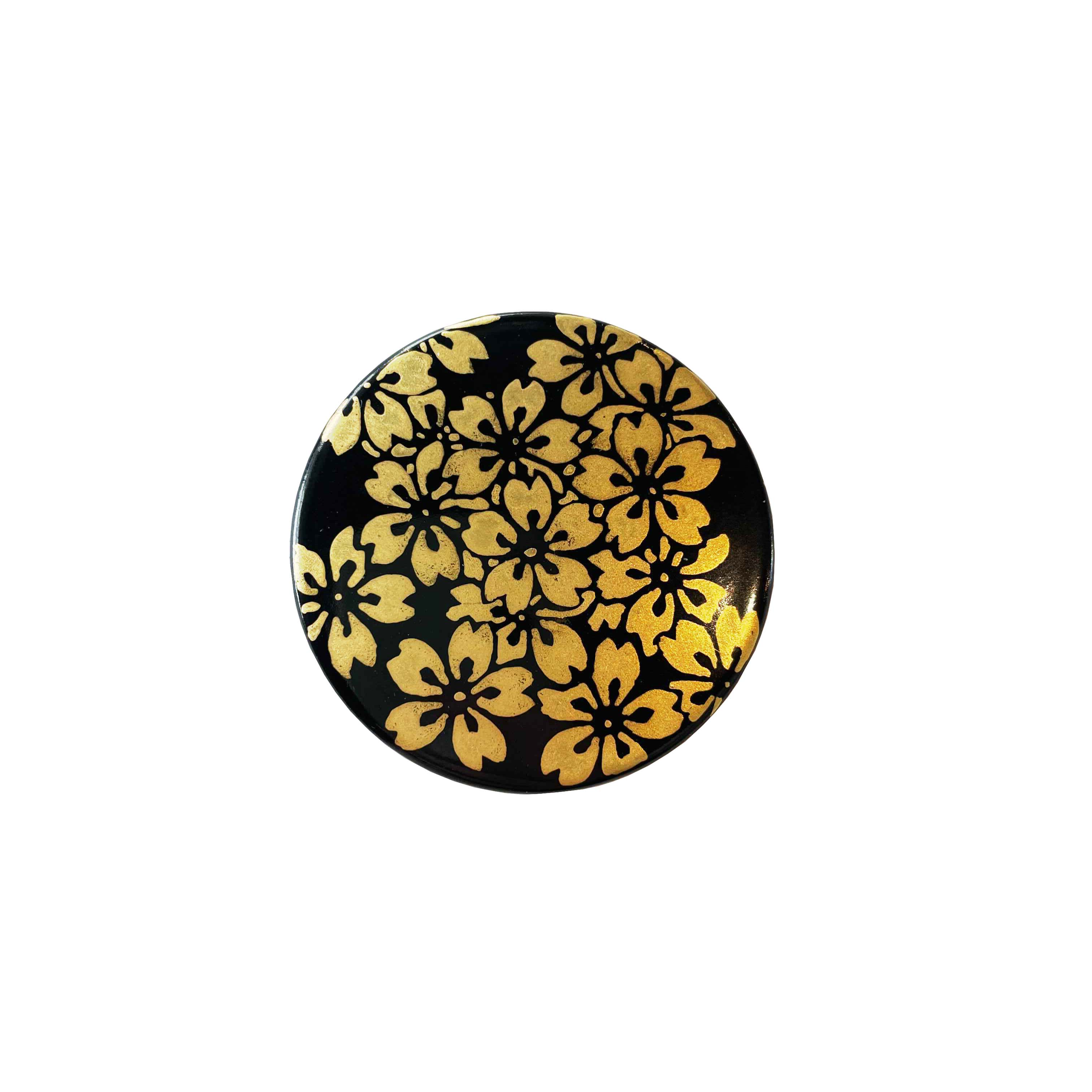
One of Japan's most familiar floral motifs, the cherry blossom has long been used in decorative arts as a symbol of new beginnings and prosperity.
Flower
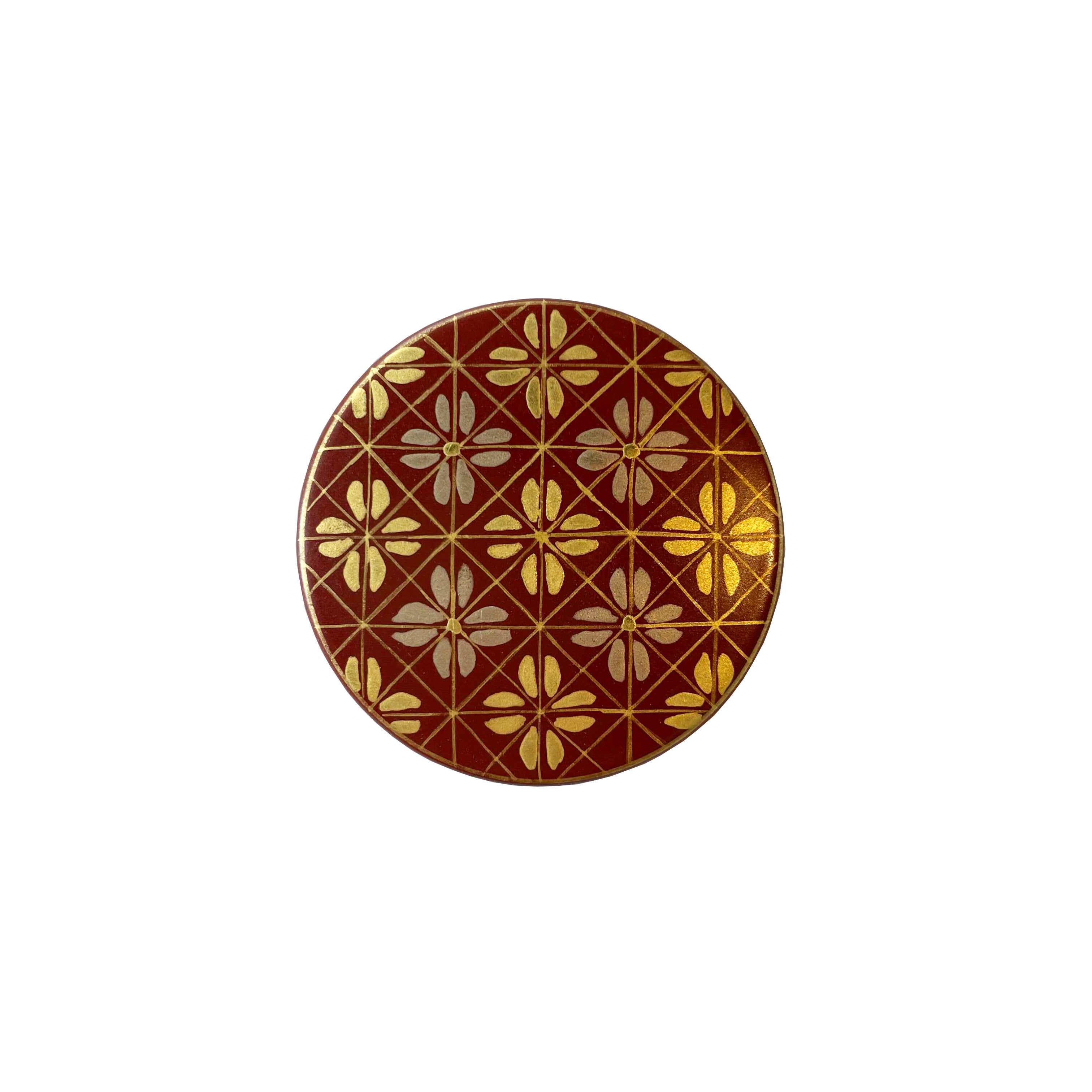
Flowers have appeared throughout Japanese craft and decorative art for centuries, representing beauty, abundance, and vitality. Even these rounded forms are built entirely from exceptionally fine lines.
Mesh
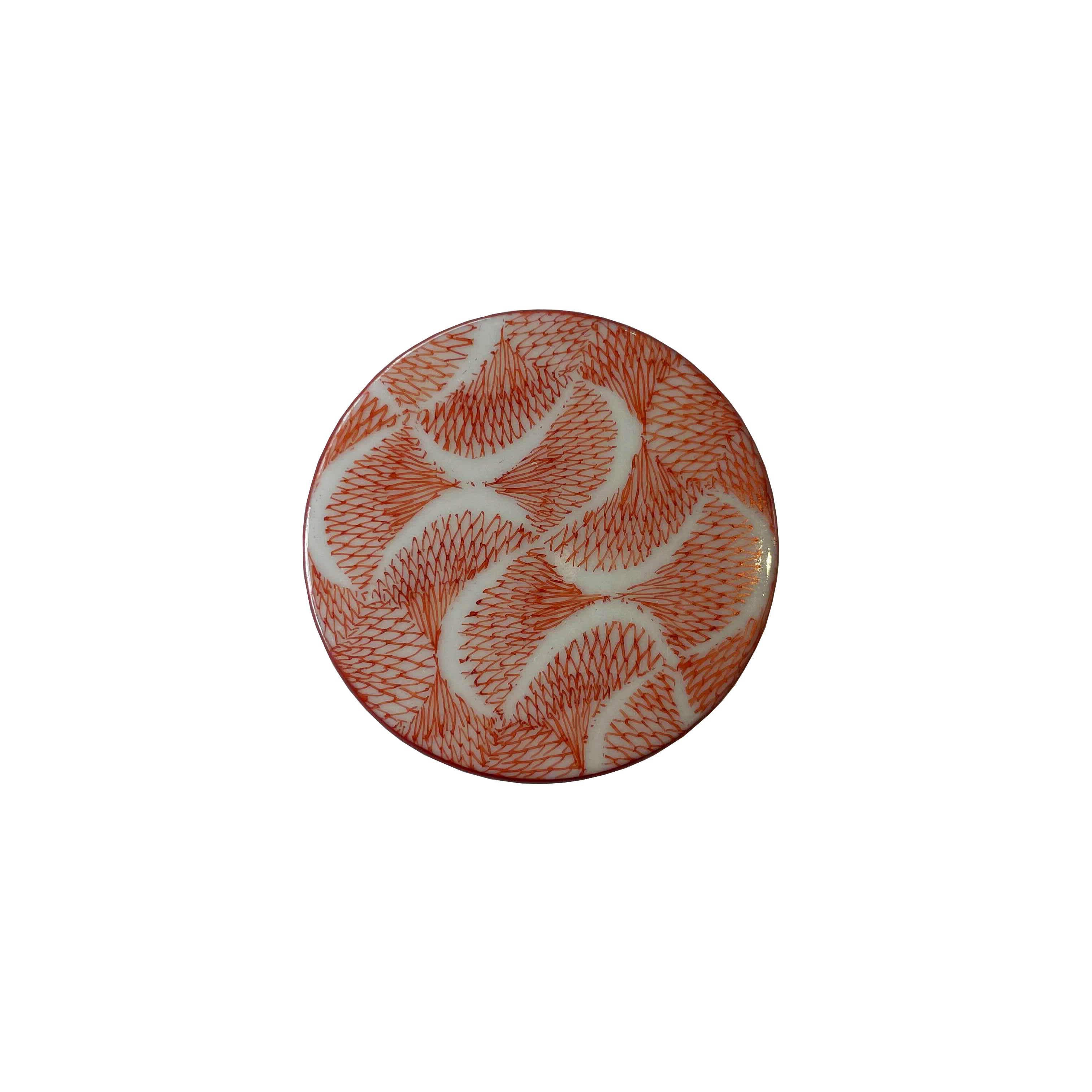
Inspired by a fisherman's net, the mesh pattern is associated with the idea of "catching happiness" or gathering good fortune, and has traditionally expressed wishes for abundance.
Chintz
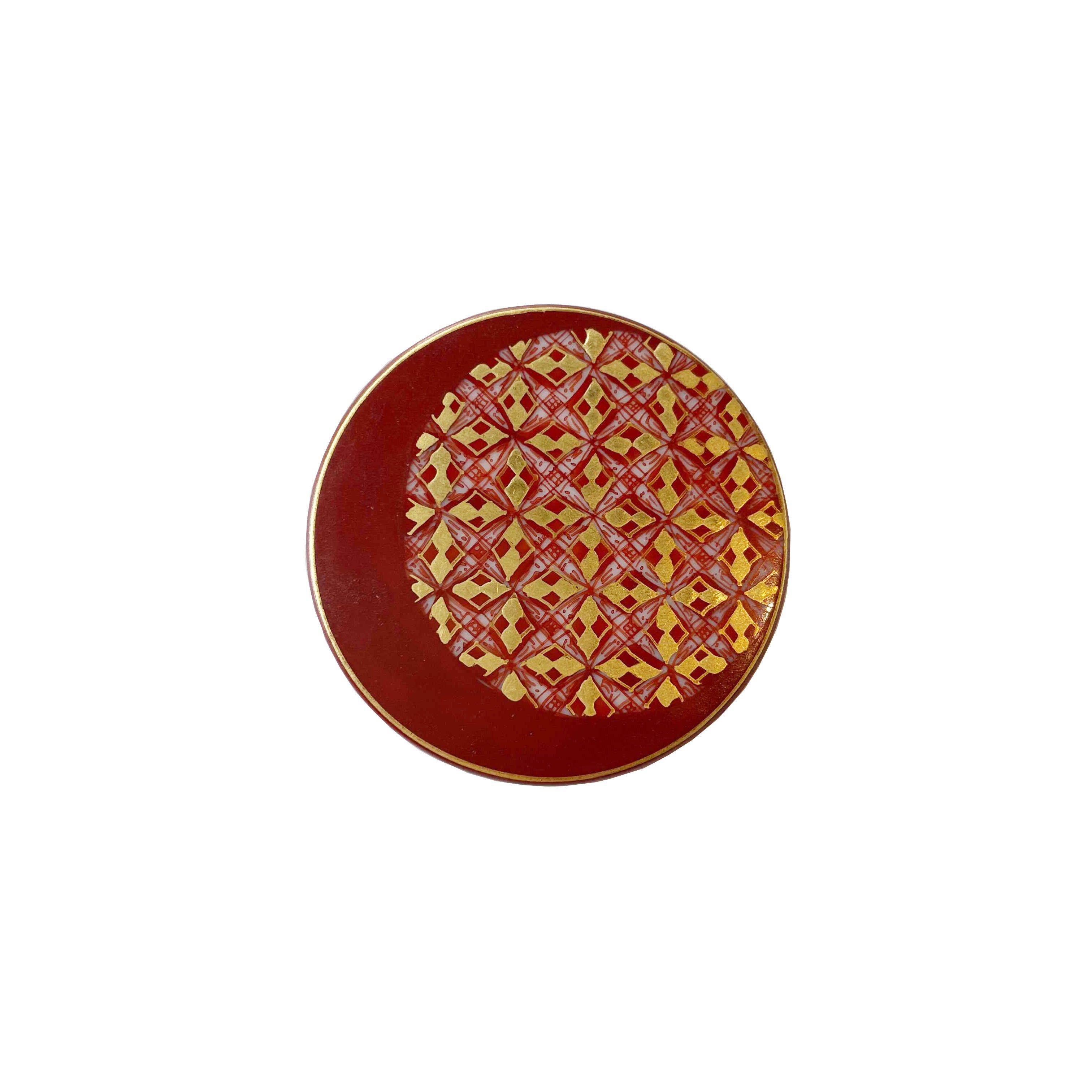
Chintz originated in India and reached Japan through Portuguese and Dutch trade from the late 16th century onward. These imported textiles went on to influence Japanese ceramics and other crafts, and the pattern remains part of the decorative vocabulary today.
The Revival of Kutani and Yoshidaya Kutani
After the original Kutani kilns ceased production, around a century passed before the tradition was revived in the early 19th century.
A succession of new kilns developed their own approaches to Kutani decoration. Among the best known is the Yoshidaya style, which revived the aote tradition using green, yellow, purple, and deep blue while excluding red. Other kilns developed increasingly detailed red painting and combinations of color and gold.
Rather than simply reproducing Ko-Kutani, this period expanded what Kutani ware could look like. Many of the styles now considered characteristic of Kutani emerged from this era of experimentation.
From "Japan Kutani" to Contemporary Kutani Ware
During the Meiji era, Kutani ware reached a much wider international audience. Elaborately decorated works were exported to Europe and the United States and exhibited at international expositions, where they became known as "Japan Kutani."
But the history of Kutani ware did not end with the styles established in the past.
Its development has repeatedly come from artists finding new possibilities within inherited techniques. Some have pushed traditional brushwork to new levels of precision; others have explored entirely new approaches to pigments, glaze, and firing.
That continuing evolution can be seen particularly clearly in the work of two contemporary Kutani artists: Kazuhiko Komekyu and Gumpu Nakamura.
Kazuhiko KomekyuMaster of Akae Saibyō
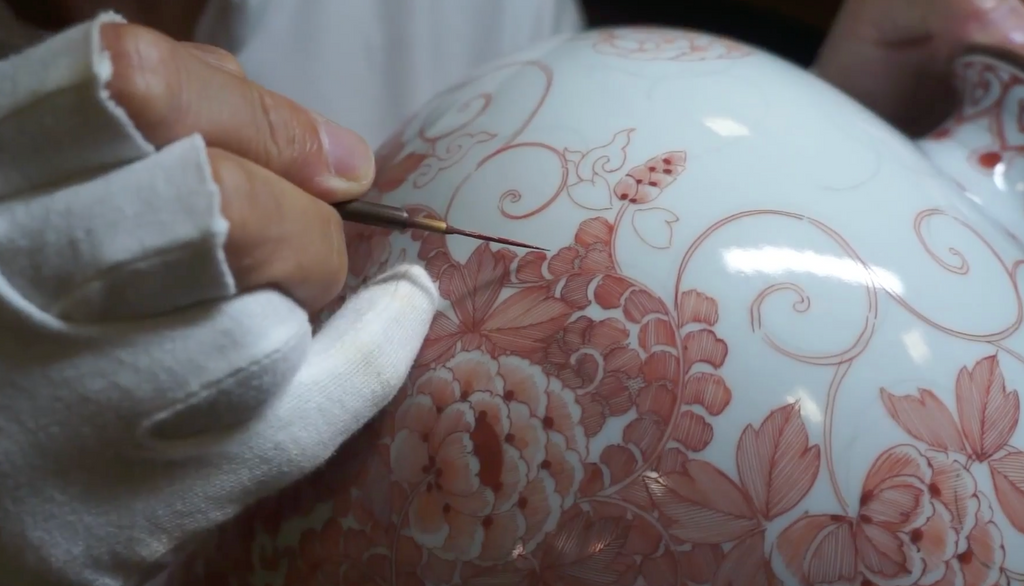
Kazuhiko Komekyu, a Kutani ware ceramicist based in Ishikawa Prefecture, works in akae saibyō — a style of fine-line painting in which minute patterns are drawn across the surface of a ceramic piece with an exceptionally fine brush. His lines can be so fine that he is able to draw three within a single millimeter.
Moving the brush slowly is not the answer. Move too slowly, and the pigment pools, and the line thickens. What the technique demands is a consistent rhythm — maintained stroke after stroke, for as long as it takes.
The Ware the World Once Called "Japan Kutani"
Within the Kutani tradition, akae — fine patterns painted in red, accented with gold — occupied a particular place. At its peak, two to three hundred craftspeople in the region practised it. Today, that number has fallen to around twenty.

Komekyu came to ceramics not from within the craft but from painting. Born in Ishikawa Prefecture in 1968, he studied oil painting at Kanazawa University of Art and Technology before turning to Kutani ware through the Ishikawa Prefecture Kutani Ware Technical Training Institute. In 1996 he established his own studio, Komekyu Kiln.
The brushes behind those fine lines have their own long preparation. A new brush cannot be used for fine-line work straight away. It is first used for preparatory sketches for around three years — long enough for the oils in the hair to dissipate. The surrounding hairs are then trimmed away, leaving only the fine central core. A brush prepared this way might be used for ten to fifteen years, carefully maintained throughout its life.
The pigments, too, are mixed by hand, their consistency shifting slightly from day to day. What Komekyu says he needs to paint is not just skill but "mental strength" and "the physical endurance to keep sitting." Each line reflects the person making it on that day — which is why no two pieces are ever quite the same.
Beyond Preservation
Fine-line painting was long considered possible only in red. The chemical properties of red iron pigment made it uniquely suited to the kind of control the technique requires. Komekyu spent years researching pigment formulations until he was able to draw the same quality of fine line in blue, green, and black — extending the visual range of a tradition previously bound to a single colour.
Rather than preserving the craft as it was received, he has used the technique as a foundation — and pushed from there. In Komekyu's work, the inheritance of Kutani ware and the restlessness of an artist who will not stop at what came before exist side by side.

Kutani Ware Porcelain Case


Small enough to fit in the palm of a hand, yet covered with intricate patterns that invite a closer look. Made in 2020 to mark Komekyu's 30th year of akae painting, the interior features a traditional mesh pattern fundamental to akae saibyō, while the exterior is decorated with a chintz motif in Komekyu's own interpretation. Display it as an object, or use it to keep something precious.
Kutani Ware Porcelain Golf Ball Marker


Within a circle just 42 mm across, Komekyu paints each pattern entirely by hand. Spinning top, cherry blossom, flower, mesh, chintz — traditional Japanese auspicious motifs, each carrying its own meaning. A small piece of Kutani ware made not only to be admired, but to be taken out onto the golf course.
Gumpu NakamuraContemporary Artist, Reinventing Kutani Color

Gumpu Nakamura came to ceramics from an unusual background in biology and ecology. Over time, he began to feel that the essence of life could not be understood through data alone, but might instead be found in art. He turned to ceramics, bringing his scientific way of thinking with him.
"Ceramics is science," Nakamura says. He develops his own glazes, measuring colour mixtures to within 0.00001 grams and controlling firing temperatures to the degree. Each colour is built through repeated applications and firings, creating the depth and luminosity of the finished surface.

One idea sits at the heart of his work: water disappears completely in the kiln, yet his pieces seem to remain wet and luminous. Nakamura calls this "the trace of water" — a presence made visible precisely because it is no longer there.
The result is a surface that feels dimensional, layered, and alive with colour and light — a distinctly personal expression within the Kutani tradition.
Kutani Sake Drinkware Set

A carafe and two cups, each surface built up through multiple glaze applications and firings. The patterns evoke natural forms — clouds, waves — deliberately left open to individual interpretation. Nakamura gives particular attention to the cups: the thickness of the rim, its angle, its texture. A sake cup, he believes, is "a medium for conversation." This set is made to be felt as much as seen.
"Memory of Water" Cup

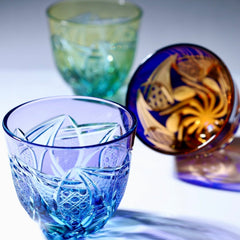
A single sake cup, named for the central question of Nakamura's practice: how to capture the trace of water in a piece from which all water has been driven out by fire. The surface appears luminous, translucent, almost wet — a quality achieved through independently developed glazes and multiple firings. Available in four colours: light blue, yellow, deep blue, and pink.
Kutani Ware Vase "Kizuna"

At first glance, the vase appears almost black. As the light shifts, traces of red, yellow, green, indigo, and violet emerge from within the glaze. The hand-drawn lattice pattern represents kizuna — the Japanese idea of bonds and connection.
Komekyu and Nakamura stand at opposite ends of the same tradition. One works through the discipline of the brush — accumulating line upon line until a pattern emerges that could only have been made by a particular person on a particular day. The other works through the logic of chemistry — measuring, layering, firing, until a surface appears that seems to hold something that fire should have taken away.
Both are rooted in the same tradition. And both are pushing it further — each in the direction only they could take it.
All products ship worldwide, with no shipping fees.
Most orders are shipped from Japan within 1–2 weeks of your order being placed. After shipment, please allow approximately 7 to 30 days for delivery, depending on your location and local customs processing times.
If you have any concerns about how an item will be handled, please don't hesitate to contact us at info@sogoo.co.jp before placing your order.