-
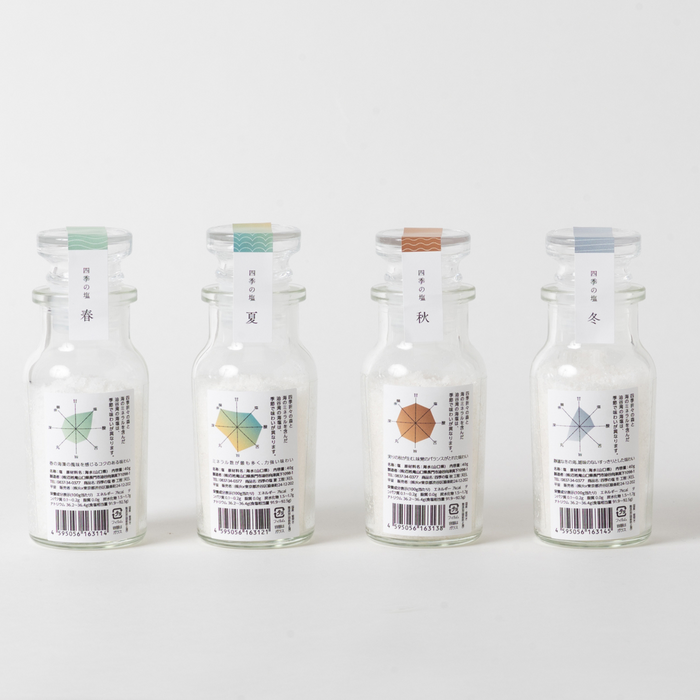
 Four-Season Japanese Sea Salt Set
 -
 Four-Season Japanese Sea Salt Set
 -
 Four-Season Japanese Sea Salt Set
 -
 Four-Season Japanese Sea Salt Set


Okawari Tokyo Four-Season Japanese Sea Salt Set
Four-Season Japanese Sea Salt Set
Couldn't load pickup availability
Seasonal sea salt · Four varieties · Hand-crafted · Yuya Bay, Yamaguchi · okawari TOKYO
Salt that changes with the seasons
The four salts in this set are drawn from the same body of water — Yuya Bay in Yamaguchi Prefecture — but at different points in the year. Spring, summer, autumn, and winter each produce seawater with a different mineral composition, because the ecosystem that feeds into the bay changes continuously through the seasons. As the forest above the bay cycles through growth and dormancy, the minerals that flow from the humus into the rivers and into the sea shift in type and concentration. The result is four salts from one place that taste meaningfully different from each other.
Spring — seaweed depth and a strong salt presence
As temperatures rise and seaweed blooms across the bay, the spring seawater carries its character into the salt. The flavor is rich and savory, with a perceptible seaweed quality — strong in saltiness, with a depth that suits the slight bitterness of spring vegetables.

Pairs well with: Butterbur shoots · rape blossoms · bamboo shoots · spring cabbage · snow peas · sea bream · octopus · clams · strawberries
Summer — the highest mineral content of the four
In summer, the forest is at full growth. Rain carries minerals from the leaf litter through two long rivers into the bay. The summer salt has the most complex mineral profile of the set — a concentrated, vital flavor that reflects the combined energy of sun, forest, and sea. A pinch over a water-rich summer vegetable makes the freshness of the ingredient more present, not less.

Pairs well with: Tomatoes · cucumber · edamame · corn · horse mackerel · conger eel · sweetfish · sardines · beef · venison · watermelon · figs
Autumn — the most balanced of the four
As leaves begin to turn and fall, organic matter and minerals from ripening seeds and fallen leaves enter the bay gradually. The autumn salt is rounder than summer — the edges softer, the five basic tastes in closer balance. It works across a wider range of ingredients, from freshly harvested rice to rich braised dishes to sake.

Pairs well with: Rice · mushrooms · eggplant · turnip · chicken · kabocha squash · taro · sweet potato · bonito · eel · Pacific saury · apples · sake
Winter — clean and precise
In winter, the forest quiets. Rain decreases, temperatures drop, biological activity in the bay slows. The seawater carries less organic material, and the resulting salt is the cleanest of the four — no off-notes, a direct and uncluttered saltiness. It works particularly well with fat-rich winter fish and long-cooked dishes, where a clean salt presence is needed without complexity competing with the depth of the main ingredient.

Pairs well with: Daikon · carrot · burdock root · spinach · komatsuna · yellowtail · pufferfish · cod · oysters · crab · corbicula · pork · citrus
A bay chosen from across all of Japan
Salt master Yuzen Inoue spent years traveling Japan looking for the ideal location to make salt. He chose Yuya Bay in Yamaguchi Prefecture — a brackish inlet surrounded by forest, approximately 80% of which is old-growth primary forest that has never been cultivated. The bay has been protected by local fishermen since the Choshu domain period under a forest conservation policy called gyofu-rin — the understanding that a healthy forest produces a healthy sea. Two long rivers carry mineral-rich water from the forest floor into the compact bay, where forest and ocean mineral sources combine in close proximity.

Yuya Bay — forest and sea minerals in close proximity
Six weeks to finish a batch
Japan has no significant underground salt deposits — unlike countries where rock salt is mined directly, Japanese salt must be made from seawater by hand, which is why craft and time are inseparable from quality. Inoue-san's process begins with the drawn seawater concentrated slowly over approximately two weeks in a three-dimensional salt flat. This is followed by four days of pre-boiling and approximately twelve hours of final boiling — the full process takes around six weeks per batch.

Salt master Yuzen Inoue

Four days pre-boil · twelve hours final boil

Tenchigaeshi — hand-turning to remove excess magnesium (nigari)
After boiling, the salt is turned by hand in a process called tenchigaeshi — literally "turning heaven and earth" — to mix the crystals evenly. Excess magnesium (nigari, the compound responsible for bitterness in salt) is then carefully removed to achieve a mineral balance closer to that of ancient seawater. The result is a salt that people describe as having the quality of dashi — a savory depth that goes beyond simple salinity.
The person behind okawari TOKYO
Kondo-san, founder of okawari TOKYO, spent years working in the cosmetics industry before arriving at a conviction: that health and wellbeing begin not with what you put on the body, but with what you put in it, every day. After becoming a parent and reconsidering the family's food from the ground up, she encountered this salt from Yuya Bay. The effect on cooking was immediate and unmistakable — and became the starting point for okawari TOKYO.

Passing essential food knowledge to the next generation

Workshops in traditional food-making — miso, salt, and more
okawari TOKYO runs workshops in traditional food preparation — miso-making and others — as a way of passing essential knowledge to the next generation. The organization also works to introduce Japanese food producers who make things with honesty and care to a wider audience.
Specifications
Set contents: Spring · Summer · Autumn · Winter salt (1 of each · 40 g each · 160 g total)
Each jar: H 4.1 × Dia. 1.7 in (105 × 43 mm)
Box dimensions: [to be added]
Best before: None
Producer: okawari TOKYO · salt master Yuzen Inoue · Yuya Bay, Yamaguchi Prefecture, Japan
Ingredients
Seawater (Yuya Bay, Yamaguchi Prefecture, Japan)
No additives
Storage
Store away from direct sunlight and humidity. No best-before date — salt does not expire.
Keep the lid closed when not in use to prevent moisture absorption and clumping.
Shipping
Ships within 10 days · Shipping cost included in price
Note
Please note that import duties, taxes, and customs clearance fees are the responsibility of the buyer. We cannot guarantee customs clearance in all countries. Products are shipped from Japan as personal imports.
Salt is generally subject to fewer import restrictions than other food categories, but buyers are encouraged to check the regulations applicable to their country before placing an order.
Please note that all product labels and packaging are written in Japanese only. Ingredient information and storage instructions are listed on this product page.
Some food products may not be eligible for shipment to certain countries or regions due to local import regulations. If we are unable to ship your order to the specified destination, we will cancel the affected item and issue a full refund.
-
Four-Season Japanese Sea Salt Set
-
Four-Season Japanese Sea Salt Set
-
Four-Season Japanese Sea Salt Set
-
Four-Season Japanese Sea Salt Set