-
 Grade A Nanko-ume Umeboshi
 -
 Grade A Nanko-ume Umeboshi
 -
 Grade A Nanko-ume Umeboshi


Azuma Noen Grade A Nanko-ume Umeboshi
Grade A Nanko-ume Umeboshi
Couldn't load pickup availability
Umeboshi · Nanko-ume Grade A · Honey-cured · Higashien · Est. 1834 · Wakayama
What umeboshi is
Umeboshi are Japanese salt-cured plums — one of the oldest preserved foods in Japan, eaten for centuries as a condiment, a digestive aid, and a daily ritual. The word breaks down simply: ume (Japanese plum) and boshi (dried). The fruit is not sweet in its raw state — it is intensely tart, high in citric acid, and has a complex, almost resinous quality that softens and deepens through the curing process. In Japan, umeboshi appears at breakfast alongside rice and miso soup, in the center of onigiri rice balls, in bento boxes, and as a palate cleanser between courses. Outside Japan, almost no equivalent exists. Godai-ume is an introduction to what umeboshi can be at its best.

Godai-ume — plump, thin-skinned, and full of fruit
The plum — Nanko-ume, Grade A
Nanko-ume is Japan's most highly regarded ume variety, developed in Minabe Town, Wakayama Prefecture in the 1940s and 1950s. The name reflects its origins: "Nanbu" (the old name for the area) and "ko" from the principal of Nanbu High School, who chaired the selection committee that designated it the finest variety. It is characterized by thin skin, thick flesh, and a high concentration of organic acids. Azuma Noen uses only Grade A Nanko-ume — fruit that is uniformly large, completely unblemished, and appropriately soft. No lesser grade enters Godai-ume.
Harvested when the plum decides it is ready
The plums are not hand-picked. Azuma Noen waits for fully ripened fruit to fall naturally from the tree — a slower, more labor-intensive approach that yields plums with softer flesh, higher organic acid content, and more developed flavor than fruit harvested early. The fallen plums are then washed in groundwater filtered through Kishu Binchotan charcoal — a high-grade activated charcoal produced in Wakayama and used in Japan for water purification.
Thirty to forty days of curing, in three stages
The cleaned plums are cured for 30 to 40 days, with the seasoning added in three separate stages rather than all at once. This allows each layer of flavor to penetrate the fruit progressively. The curing liquid has been in continuous use for 30 years — accumulated flavor that cannot be replicated from scratch. Desalting, which in standard production is done quickly with water or hot water, is done here in the curing liquid itself over three to four times the usual duration, so the natural flavor of the plum is preserved rather than washed out.
Salt at half the conventional level — still fully flavored
Traditional umeboshi cured in salt alone contains around 20% sodium. Goshiro-ume contains 10% — half that level. The balance is achieved not by simply reducing salt, but by introducing honey, hon-mirin (a traditional Japanese sweet rice wine), and apple cider vinegar: sweetness, depth, and a clean acidity that complement rather than mask the plum's own sourness. The result is umeboshi that is rounded and mellow where standard versions can be sharp and one-dimensional.
Founded in 1834 — in the place where umeboshi began
Azuma Noen was established in 1834 in Wakayama Prefecture — the region credited with originating both the Nanko-ume variety and the broader tradition of umeboshi production in Japan. The farm and producer have remained in the same region across generations, working with the same fruit and the same methods, continuously refined.
How to eat umeboshi
The simplest way: eat one alongside a bowl of plain steamed rice. The sourness and saltiness of the plum cut through the starch and make each mouthful more distinct. Umeboshi also works well chopped and mixed into salad dressings, stirred into pasta with olive oil and shiso, spread on toast with cream cheese, or dissolved into hot water as a simple restorative drink. Each plum contains a pit — exercise care when eating.
Specifications
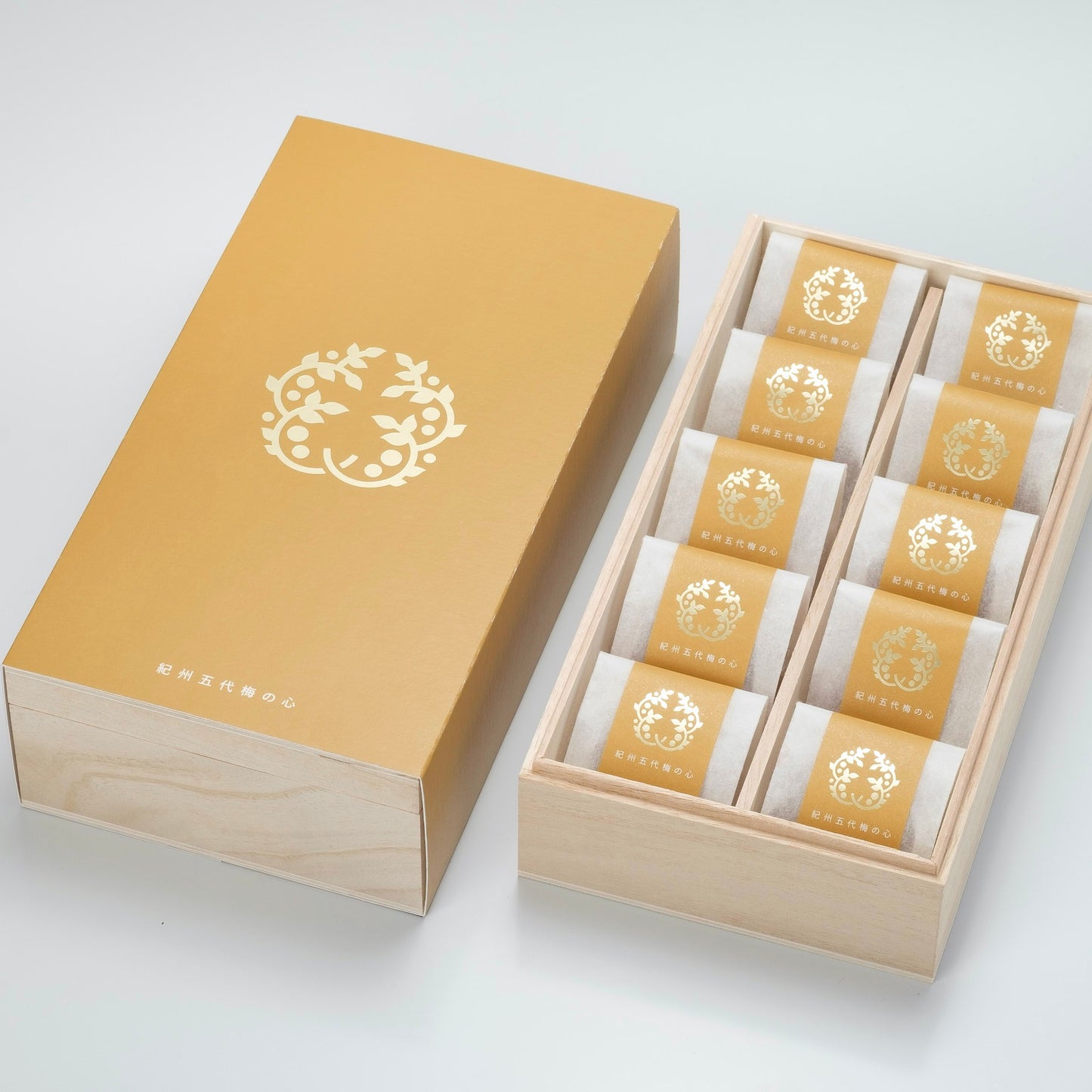
Contents: 10 large-grade plums · 515 g total weight
Plum variety: Nanko-ume, Grade A (Wakayama Prefecture, Japan)
Salt content: 10% (per 100 g edible portion)
Packaging: Wooden gift box · W 4.9 × D 9.4 × H 2.6 in (125 × 240 × 65 mm)
Best before: 8 months from date of manufacture
Producer: Azuma Noen · Est. 1834 · Wakayama Prefecture, Japan
Ingredients
Ume plum (Wakayama, Japan) · salt · sugars (sugar · oligosaccharide) · reduced starch syrup · hon-mirin · apple cider vinegar · honey · seasoning (amino acids: soy-derived) · sake · acidulant · sweetener (stevia) · vegetable color · vitamin B1
Contains: Soy · apple
May contain: Apple
Storage
Before opening: store away from direct sunlight, heat, and humidity.
After opening: refrigerate and consume as soon as possible.
Shipping
Ships within 10 days · Shipping cost included in price
Note
Each plum contains a pit. The tip of the pit may be sharp — take care when eating.
Please note that import duties, taxes, and customs clearance fees are the responsibility of the buyer. We cannot guarantee customs clearance in all countries. Products are shipped from Japan as personal imports.
Preserved plum products are subject to food import regulations in some countries. Australia requires declaration of all food products at the border, and items may be subject to inspection. Buyers are encouraged to check the import regulations applicable to their country before placing an order.
Please note that all product labels and packaging are written in Japanese only. Ingredient information and storage instructions are listed on this product page.
Some food products may not be eligible for shipment to certain countries or regions due to local import regulations. If we are unable to ship your order to the specified destination, we will cancel the affected item and issue a full refund.
-
Grade A Nanko-ume Umeboshi
-
Grade A Nanko-ume Umeboshi
-
Grade A Nanko-ume Umeboshi