-
 Hand-Turned Salt Mill
Donburi: Diameter 2.5 in (63 mm) · H 5.9 in (150 mm) / Elm -
 Hand-Turned Salt Mill
 -
 Hand-Turned Salt Mill
 -
 Hand-Turned Salt Mill
Donburi: Diameter 2.5 in (63 mm) · H 5.9 in (150 mm) / Elm -
 Hand-Turned Salt Mill
Donburi: Diameter 2.5 in (63 mm) · H 5.9 in (150 mm) / Elm -
 Hand-Turned Salt Mill
Donburi -
 Hand-Turned Salt Mill
 -
 Hand-Turned Salt Mill
Hechima: Diameter 2.4 in (62 mm) · H 7.3 in (185 mm) / Cherry -
 Hand-Turned Salt Mill
Hechima: Diameter 2.4 in (62 mm) · H 7.3 in (185 mm) / Cherry -
 Hand-Turned Salt Mill
Hechima: Diameter 2.4 in (62 mm) · H 7.3 in (185 mm) / Cherry -
 Hand-Turned Salt Mill
Seattle Tower: Diameter 3.0 in (76 mm) · H 9.0 in (228 mm) / Chestnut -
 Hand-Turned Salt Mill
Seattle Tower: Diameter 3.0 in (76 mm) · H 9.0 in (228 mm) / Chestnut -
 Hand-Turned Salt Mill
Seattle Tower: Diameter 3.0 in (76 mm) · H 9.0 in (228 mm) / Chestnut -
 Hand-Turned Salt Mill
Uranaishi: Diameter 2.7 in (68 mm) · H 3.9 in (100 mm) / Amur Cork Tree -
 Hand-Turned Salt Mill
Uranaishi: Diameter 2.7 in (68 mm) · H 3.9 in (100 mm) / Amur Cork Tree


Wood Works Yamani Hand-Turned Salt Mill
Hand-Turned Salt Mill
Couldn't load pickup availability
Wood-turned salt mill · One of a kind · Nagano, Japan
Born from demand
Yamani Workshop built their name on pepper mills — wood-turned, one of a kind, made by a pepper obsessive in Nagano. The salt mill came later, by popular request. Customers wanted a companion piece: same craft, same silhouette sensibility, made to sit alongside the pepper mill on the table.

The moment you grind, the salt releases
Turned one at a time on a wood lathe
Every mill is shaped on a lathe — the same tool Shohei Uchiyama uses for furniture legs and architectural joinery. He works with over 20 species of wood: cherry, oak, walnut, and others, each chosen for its color, grain, and the way it responds to the lathe. Because the wood is natural and the turning is done by hand, each piece has its own character. The form you receive is the only one of its kind.

Turned one by one on a wood lathe
The names are part of it
Each design is named by Shohei's wife Mirai — after the silhouettes the forms suggest. She also handles assembly. The mills are a collaboration: his obsession with form and grind, her eye for what each shape becomes.

A selection of designs available at By Emotion
A grind mechanism chosen by a professional obsessive
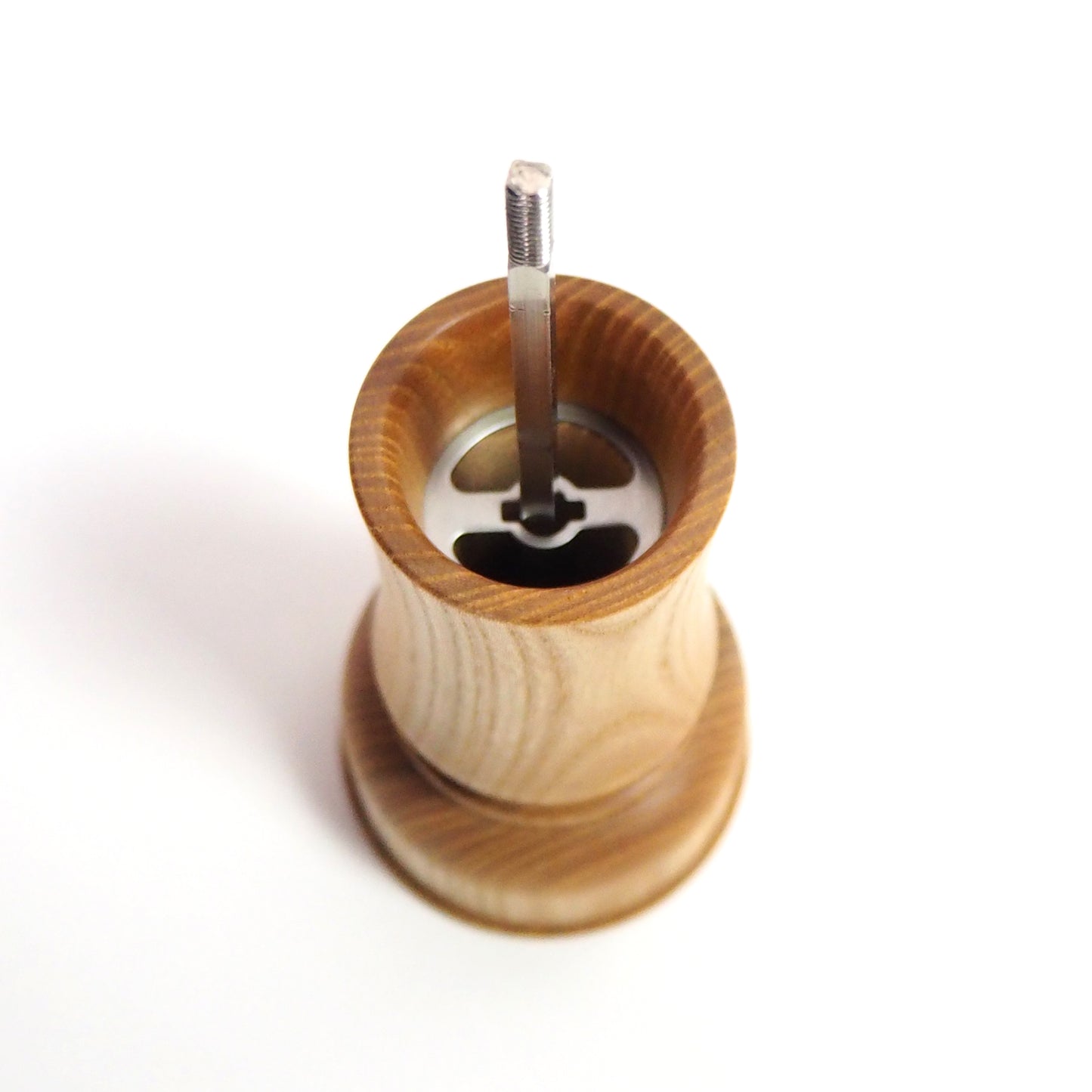
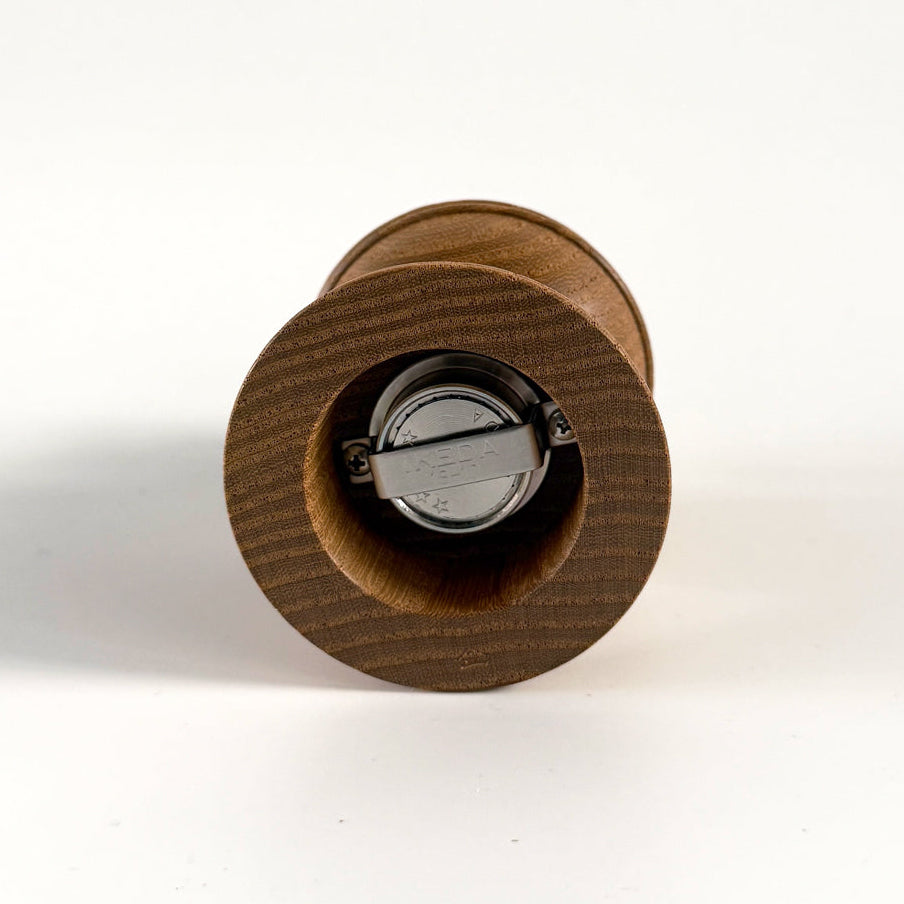
The grinding mechanism matters as much as the wood. Shohei tested many before choosing IKEDA — a domestic Japanese manufacturer whose cast-iron burrs are used by professional chefs. He wrote them what he called "a love letter" asking to use their mechanism in his mills. The cast-iron burr is adjustable: tighten the top screw for a fine powder, loosen it for a coarse crack. The resistance when you grind — that particular sound and feel — is part of why people keep reaching for it.

Grinding mechanism by IKEDA — adjustable coarseness
Every design starts as a drawing
Shohei draws every form before he turns it. Different wood species require different lathe speeds, different tool pressures, different drying times — so each design is tuned to the material. Over 300 designs have come out of this process so far, and the work is still evolving.
"There was a ramen shop near where I grew up that had this green onion ramen absolutely buried in pepper. The first time I had it, something just opened up in me. I went deep into pepper from there — buying every mill I could find, comparing them. Eventually I thought: I work with wood, I can just make my own."
— Shohei Uchiyama, maker


Every design is drawn before production begins
"Wood species vary in hardness, which affects how fast the lathe wears and how the piece responds to cutting. I adjust my approach for each one."
— Shohei Uchiyama, maker
Within two years of making mills for others, Yamani Workshop began attracting attention from design-conscious select shops. The catalog keeps growing — not because of a strategy, but because Shohei hasn't gotten bored yet.
"A lot of it comes from the fact that I'm genuinely enjoying it — it started as a hobby extension and I haven't stopped finding it interesting. People tell me the work has changed even in two years. I'm curious to see where it goes."
— Shohei Uchiyama, maker

Warm grain, distinctive presence
Specifications
Body: Solid wood · oil finish
Grinding mechanism: Cast iron (IKEDA, Japan)
Adjustment screw: Brass (silver)
Each piece is one of a kind — wood species and dimensions vary by variant
Seattle Tower: Diameter 3.0 in (76 mm) · H 9.0 in (228 mm) / Chestnut
Uranaishi: Diameter 2.7 in (68 mm) · H 3.9 in (100 mm) / Amur Cork Tree (Phellodendron amurense)
Donburi: Diameter 2.5 in (63 mm) · H 5.9 in (150 mm) / Elm
Hechima: Diameter 2.4 in (62 mm) · H 7.3 in (185 mm) / Cherry
Shipping
Ships within 5 business days · Shipping cost included in price
Care
Do not wash with water — wipe clean with a dry cloth only.
Keep away from direct sunlight, high humidity, and heat sources.
If the surface feels dry, apply a small amount of beeswax or food-safe oil and wipe off thoroughly.
If storing for an extended period, remove the contents and loosen the adjustment screw slightly to prevent deterioration of the mechanism.
Natural color change over time is a characteristic of the wood.
How to Use
① Remove the adjustment screw and top cap, then fill with rock salt.
② Loosen the screw slightly, hold the body, and rotate clockwise to grind.
· Turn the screw to adjust coarseness: tighter for fine, looser for coarse.
· Do not rotate the top cap with the screw fully tightened — this may damage the mechanism.
Recommended: Rock salt ◎
Not suitable: Sea salt ✕
Use dry rock salt between 2 — 5 mm in size. Some shapes may not grind evenly.
-
Hand-Turned Salt Mill
Donburi: Diameter 2.5 in (63 mm) · H 5.9 in (150 mm) / Elm -
Hand-Turned Salt Mill
-
Hand-Turned Salt Mill
-
Hand-Turned Salt Mill
Donburi: Diameter 2.5 in (63 mm) · H 5.9 in (150 mm) / Elm -
Hand-Turned Salt Mill
Donburi: Diameter 2.5 in (63 mm) · H 5.9 in (150 mm) / Elm -
Hand-Turned Salt Mill
Donburi -
Hand-Turned Salt Mill
-
Hand-Turned Salt Mill
Hechima: Diameter 2.4 in (62 mm) · H 7.3 in (185 mm) / Cherry -
Hand-Turned Salt Mill
Hechima: Diameter 2.4 in (62 mm) · H 7.3 in (185 mm) / Cherry -
Hand-Turned Salt Mill
Hechima: Diameter 2.4 in (62 mm) · H 7.3 in (185 mm) / Cherry -
Hand-Turned Salt Mill
Seattle Tower: Diameter 3.0 in (76 mm) · H 9.0 in (228 mm) / Chestnut -
Hand-Turned Salt Mill
Seattle Tower: Diameter 3.0 in (76 mm) · H 9.0 in (228 mm) / Chestnut -
Hand-Turned Salt Mill
Seattle Tower: Diameter 3.0 in (76 mm) · H 9.0 in (228 mm) / Chestnut -
Hand-Turned Salt Mill
Uranaishi: Diameter 2.7 in (68 mm) · H 3.9 in (100 mm) / Amur Cork Tree -
Hand-Turned Salt Mill
Uranaishi: Diameter 2.7 in (68 mm) · H 3.9 in (100 mm) / Amur Cork Tree