-
 Japanese Cutlery Set
3 piece set / silver -
 Japanese Cutlery Set
3 piece set / silver -
 Japanese Cutlery Set
black -
 Japanese Cutlery Set
3 piece set / white -
 Japanese Cutlery Set
3 piece set / white -
 Japanese Cutlery Set
3 piece set / gold -
 Japanese Cutlery Set
3 piece set / rose -
 Japanese Cutlery Set
3 piece set / black -
 Japanese Cutlery Set
5 piece set / gold -
 Japanese Cutlery Set
5 piece set / black -
 Japanese Cutlery Set
3 piece set / white -
 Japanese Cutlery Set
3 piece set / black -
 Japanese Cutlery Set
3 piece set / gold -
 Japanese Cutlery Set
3 piece set / rose -
 Japanese Cutlery Set
5 piece set / silver -
 Japanese Cutlery Set
5 piece set / white -
 Japanese Cutlery Set
5 piece set / black -
 Japanese Cutlery Set
6 piece set / silver -
 Japanese Cutlery Set
6 piece set white -
 Japanese Cutlery Set
6 piece set / black -
 Japanese Cutlery Set
6 piece set / gold -
 Japanese Cutlery Set
6 piece set / rose -
 Japanese Cutlery Set
box for 3 piece set -
 Japanese Cutlery Set
box for 5 and 6 piece set


Nakano Kagaku Japanese Cutlery Set
Japanese Cutlery Set
Couldn't load pickup availability
Stainless steel cutlery · Five finishes · Tsubame, Niigata
A cutlery set designed from the way Japanese people actually eat
In Japan, chopsticks are used at almost every meal — not only for rice and fish, but often for Western-style dishes too. SUGATA was designed from this reality: not to replicate the decorated tradition of European cutlery, but to strip it back the way chopsticks do. Less ornament, more precision.

Rose
Balanced like chopsticks
Western cutlery usually carries its weight toward the front. Chopsticks do the opposite: the balance sits toward the back, and the tip settles at the right angle on its own. SUGATA brings this balance to the fork, spoon, and knife. Each piece has a slightly different handle thickness, tuned so that it meets food at a natural angle without any adjustment from the hand.
The spoon bowl was shaped with the same care: deep enough to hold a good mouthful, yet shallow enough to slip in and out of the mouth without opening wide. The design was refined by having many different people eat with it.
"We pursued a bowl depth that was enough to hold food without requiring the mouth to open wide — something that works for both men and women. We tested it by having many different people eat with it. The handle thickness is also different for each piece — fork, spoon, knife — so that each one naturally arrives at the right angle, like chopsticks."
— Nakano, Nakano Kagaku
Three specialists, more than two years
SUGATA was born in Tsubame-Sanjo, Niigata, the center of Japanese metalworking for more than 400 years. Three specialists came together to make it: Yamazaki Kinzoku Kogyo, the Tsubame maker whose cutlery has been used at the Nobel Prize banquet; Nakano Kagaku, a surface-finishing company founded in Tsubame in 1956; and Akiko Tsurumoto, a brand consultant and producer with decades of experience in art and design worldwide.
It took more than two years of trial and error to arrive at the final form.

Five finishes, each made a different way
Nakano Kagaku tested a wide range of its own finishing techniques on SUGATA and chose the five best suited to it. No paint or dye is used on any of them.
White
A special matte treatment by Nakano Kagaku. A fine texture on the surface creates a soft, silky white with no gloss. Lovely for everyday meals, and especially for desserts.
Silver
Mirror-polished to the same standard as the cutlery used at the Nobel Prize banquet, with a clean, bright shine.
Black
Colored by oxide coloring: the steel's own oxide film is thickened until it appears black. No paint, no coating — a deep black that will not peel.
Gold
24-karat gold plating over a finely polished surface, for celebrations and special occasions.
Rose
Pink gold plating, an alloy of 24-karat gold and copper. A warm tone that brings to mind fine jewelry.
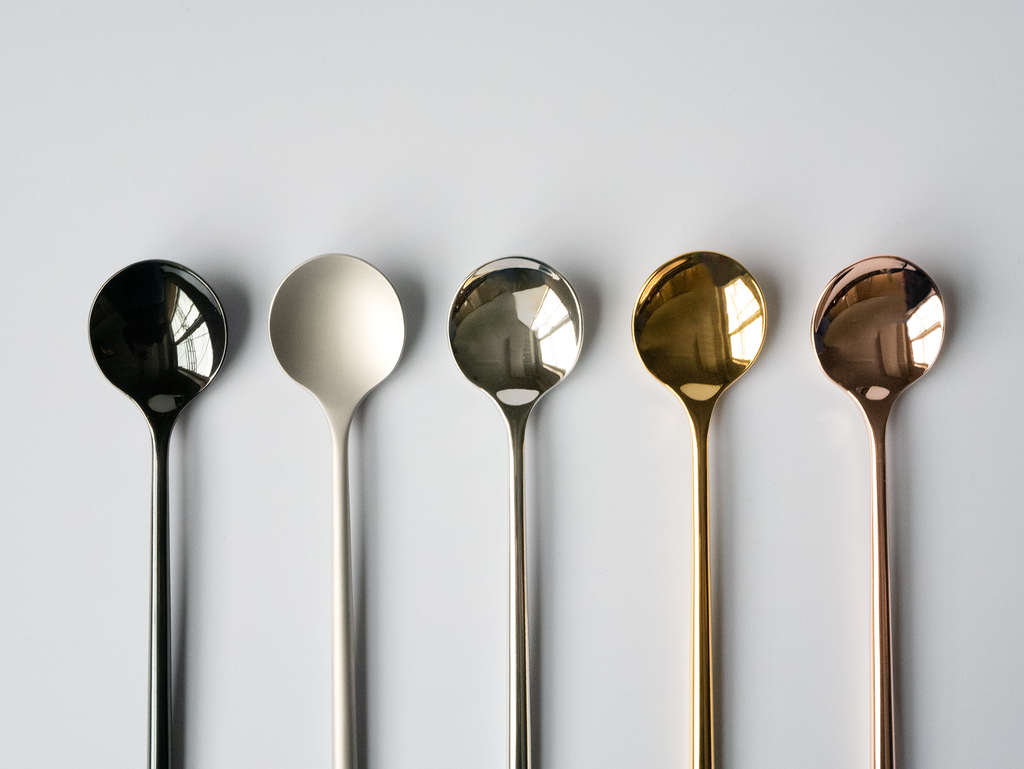
Left to right: Black · White · Silver · Gold · Rose

MORE FROM THIS BRAND
Nakano Kagaku
VIEW THE COLLECTION →
Specifications
Material
Stainless steel 18-8
Finishes
White: special matte treatment
Silver: mirror polish
Black: oxide coloring
Gold: 24k gold plating
Rose: pink gold plating
No paint or dye used
Set options
3-piece set: Dinner spoon · dinner fork · dinner knife (1 each)
5-piece set: Dinner spoon · dinner fork · dinner knife · teaspoon · dessert fork (1 each)
6-piece set: Dinner spoon · dinner fork · dinner knife (2 each)
Dimensions and weight
Dinner spoon: W 1.4 × L 7.5 in (36 × 190 mm) · 1.4 oz (40 g)
Teaspoon: W 1.2 × L 5.5 in (30 × 140 mm) · 0.7 oz (20 g)
Dinner fork: W 0.9 × L 7.9 in (24 × 200 mm) · 1.4 oz (40 g)
Dessert fork: W 0.7 × L 5.7 in (18 × 145 mm) · 0.7 oz (20 g)
Dinner knife: W 0.8 × L 8.7 in (20 × 220 mm) · 1.8 oz (50 g)
Shipping
Ships within 10 days · Shipping cost included in price
Care
Wash soon after use with a neutral detergent and a soft sponge, then dry thoroughly with a soft cloth.
Do not use cleansers, steel wool, scrubbing brushes, or acidic, strongly alkaline, or chlorine-based cleaners.
Do not leave pieces wet or in humid conditions, including after a dishwasher cycle. The knife in particular is more prone to rust.
Dishwasher
White, Silver, and Black: dishwasher safe. Use a neutral or mildly alkaline detergent, wash at 80°C (176°F) or below, keep pieces away from the hot-air outlet, and secure them so they do not knock against other items.
Gold and Rose: not dishwasher safe, as the finish is plated. Please wash by hand.
Scratches
The White and Black surfaces are as hard as ordinary stainless steel, but impact or sharp objects can scratch them. A scratch reveals the natural silver of the steel underneath; the color around it will not peel further.
Note
White: Oils or tea can settle into the fine matte texture and leave marks. The amount is minute and does not affect safety or hygiene. To lighten them, soak in warm water with a little neutral detergent, then wash. Marks become less likely with continued use. Over time, White may also take on a slightly deeper tone from everyday handling, much like ceramics developing character with age.
Black: Because oxide coloring relies on the reflection of light, slight variations in tone may appear from piece to piece. This is a natural characteristic of the technique, not a defect, and gives each piece its own character.
Gold and Rose: The plating may gradually wear with use. This is a natural characteristic of plated cutlery and does not affect food safety.
-
Japanese Cutlery Set
3 piece set / silver -
Japanese Cutlery Set
3 piece set / silver -
Japanese Cutlery Set
black -
Japanese Cutlery Set
3 piece set / white -
Japanese Cutlery Set
3 piece set / white -
Japanese Cutlery Set
3 piece set / gold -
Japanese Cutlery Set
3 piece set / rose -
Japanese Cutlery Set
3 piece set / black -
Japanese Cutlery Set
5 piece set / gold -
Japanese Cutlery Set
5 piece set / black -
Japanese Cutlery Set
3 piece set / white -
Japanese Cutlery Set
3 piece set / black -
Japanese Cutlery Set
3 piece set / gold -
Japanese Cutlery Set
3 piece set / rose -
Japanese Cutlery Set
5 piece set / silver -
Japanese Cutlery Set
5 piece set / white -
Japanese Cutlery Set
5 piece set / black -
Japanese Cutlery Set
6 piece set / silver -
Japanese Cutlery Set
6 piece set white -
Japanese Cutlery Set
6 piece set / black -
Japanese Cutlery Set
6 piece set / gold -
Japanese Cutlery Set
6 piece set / rose -
Japanese Cutlery Set
box for 3 piece set -
Japanese Cutlery Set
box for 5 and 6 piece set