-
 Susumuya Chaten Susumu Kyusu 2 Teapot
A lightweight, compact design that's easy to handle, even for smaller hands (capacity: 10.1 fl oz / 300 ml) -
 Susumuya Chaten Susumu Kyusu 2 Teapot
The double-walled lid stays cool when you hold it down, so pouring one-handed is easy -
 Susumuya Chaten Susumu Kyusu 2 Teapot
The double-walled lid stays cool when you hold it down, so pouring one-handed is easy -
 Susumuya Chaten Susumu Kyusu 2 Teapot
Holds approx. 10.1 fl oz (300 ml) — a little over one large teacup, or two small ones -
 Susumuya Chaten Susumu Kyusu 2 Teapot
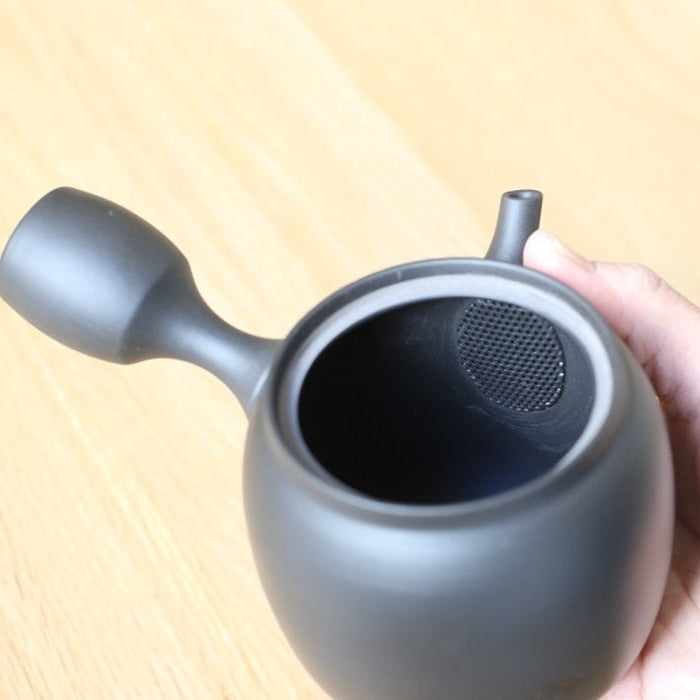
Fitted with a sasame ceramic strainer — used leaves wash out with just two or three rinses under running water


Susumuya Chaten Susumu Kyusu 2 Teapot
Susumu Kyusu 2 Teapot
Couldn't load pickup availability
Tokoname Red Clay · Slip-Cast · Approx. 7 oz (200 g)
- 01 Slip-cast with thin walls, it weighs only about 7 oz (200 g)
- 02 A double-walled lid stays cool, so you can hold it with your thumb and pour one-handed
- 03 A fine built-in strainer that rinses clean in two or three passes under the tap
Light and compact: a Tokoname clay teapot with simple, functional beauty
You would like to brew tea in a proper teapot, but a heavy, bulky one feels like a chore. This is the teapot for you. The Susumu Kyusu 2 is an original design by tea specialist Susumuya Chaten; a kyusu is the Japanese teapot with a handle set on its side. It keeps the functional beauty of its popular predecessor, the Susumu Kyusu, while slip casting (ikomi) — pouring liquid clay into a mold — gives it thin walls and a weight of only about 200 g (7.1 oz). It is easy to handle with one hand, even for people with smaller hands.

A size and weight that are easy to handle
Its rounded shape makes it look small, but it holds about 300 ml (10.1 fl oz) — a little over one large teacup, or two small ones, just right for one or two people. Because it is relatively tall, its diameter stays small, so it takes up little space and fits neatly even in a crowded kitchen.
The double-walled lid is its signature feature. It stays cool to the touch, so even with small hands you can hold down the rim of the lid with your thumb and pour with one hand. That makes it just as useful for piping-hot hojicha, a roasted green tea, as for sencha, Japan's everyday green tea. It uses a sasame strainer — a ceramic strainer of fine holes built into the pot — which draws out the full flavor of the tea. The opening looks narrow, but the interior is shaped like a cone, so used leaves wash out completely with just two or three rinses under running water.

The lid stays cool to the touch, for easy one-handed pouring

The sasame strainer, designed to draw out the full flavor of the tea
It is a genuine teapot made of shudei, the red clay of Tokoname, yet it is also a pot that grows with you: tea tannins and the natural oils from your hands soak in with use, so it gradually develops a character all its own. Small and light yet with real presence, it settles naturally into a kitchen or onto a dining table. Tokoname, in Aichi Prefecture in central Japan, is one of the country's Six Ancient Kilns and has long been known for its teapots.
For your own home, or as a gift for someone who loves Japanese tea. Functional beauty, where simple is best.
Choosing tea the way you choose coffee — Kagoshima green tea, presented honestly
Susumuya Chaten is a Japanese tea specialist born from a tea wholesaler with more than 100 years of history in Kagoshima, the prefecture at the southern tip of Kyushu. It deals exclusively in Kagoshima tea, including Chiran and Kirishima teas, named for growing districts within the prefecture. Its fourth-generation president, Kotaro Shinbara, set out to address a contradiction.
"Kagoshima is one of Japan's leading tea regions, and it has now overtaken Shizuoka to become the country's largest producer — it grows a full third of all Japanese tea. Yet most of it is shipped out of the prefecture and disappears as raw material for blends. The region's name never makes it onto the label, there are few specialist tea shops in Kagoshima itself, and the tea simply sits on supermarket shelves. I want to change how little Kagoshima tea is recognized compared with tea from Shizuoka or Kyoto."
— Kotaro Shinbara, President, Susumuya Chaten
"To share the true quality of Kagoshima tea, just as it is." That wish is where Susumuya Chaten began.
Kagoshima is also known for producing more single-cultivar teas than other regions. In a place where cultivars such as Saemidori, Asatsuyu and Yutakamidori all thrive, Susumuya Chaten's defining approach is a light roast and original blends, each designed to bring out the full character of individual cultivars.

Kagoshima tea, grown from a wide range of cultivars
Just as coffee drinkers choose their beans and roast level, green tea tastes entirely different depending on the cultivar and how long the fresh leaves are steamed. Susumuya Chaten wants to bring the pleasure of knowing those differences — and finding your own favorite cup — into everyday life. Aiming to build a Japanese café culture around tea, much as one has grown around coffee, it runs relaxed, unpretentious tea shops in Kagoshima and Tokyo.

Susumuya Chaten's flagship store in Kagoshima
Sweetness, aroma and color: first-flush green tea, hand-selected and lightly roasted
Susumuya Chaten uses only ichibancha — the first flush, picked in the year's first harvest — and finishes it with its own light roast. Keeping the leaves as close as possible to their fresh state draws out each cultivar's natural flavor, but it leaves no room to hide flaws, and judging the heat demands real skill.

A demanding technique that keeps the leaves close to fresh, drawing out their natural flavor
It all begins with selecting the leaves. Every year in Kagoshima, tea from farms across the prefecture is sold at auction. As a tea master, Shinbara tastes hundreds of lots side by side to identify the finest of the year. Even tea from the same farm changes from year to year with the weather and growing conditions, so he starts from zero each season, committed to choosing that year's very best leaf.

Kotaro Shinbara, president and tea master of Susumuya Chaten
The chosen leaves are carefully sorted by the tea master into two grades according to shape, size and condition, then lightly roasted. Because Japanese green tea is so simple, the character of the land and of the people who make it comes straight through in its flavor and aroma.

Sorted by hand into two grades by shape, size and condition, then lightly roasted
This roasting method, kept unchanged since the shop was founded, is behind what customers tell them: "I can't drink any other tea now," and "It was so good when I received it as a gift that now I want to give it to someone myself." Only when sweetness, aroma and suishoku — the color of the brewed tea — all come together does it become Susumuya Chaten tea.
In Kagoshima, properly cold winters let the leaves store up sweetness, and flat growing land makes careful cultivation possible. Susumuya Chaten visits the farms in person and builds close relationships with the growers. Shinbara believes that sharing with them the story of where their tea ends up, and who drinks it, also helps protect its quality.
No special tools or formal rituals are needed. It doesn't even have to be a kyusu, the traditional side-handled Japanese teapot. Building a culture in which tea fits naturally into daily life, in whatever form suits each person — that remains Susumuya Chaten's constant goal.
Japanese tea culture, matcha included, is drawing growing attention from around the world. With that momentum behind it, Susumuya Chaten continues to share the richness of a single cup of tea from Kagoshima, in Japan and beyond.

Sharing Japanese tea with the world, from Kagoshima
MORE TEA & TEAWARE
Susumuya Chaten
VIEW THE COLLECTION →
If you’re new to Japanese tea, or would like to enjoy it even more, please also take a look at the guide below.

FOR THE PERFECT CUP
How to Brew Japanese Tea for the Best Flavor
READ THE GUIDE →
Specifications
Brand: Susumuya Chaten
Material: Shudei red clay (Tokoname ware)
Capacity: approx. 10.1 fl oz (300 ml)
Weight: approx. 7.1 oz (200 g)
Dimensions: W 5.9 in (150 mm) incl. handle × H 3.7 in (95 mm) incl. handle
Diameter: 3.7 in (95 mm)
Strainer: Sasame ceramic strainer (suitable for fine, deep-steamed tea)
Shipping
Ships within 10 business days · Shipping cost included in price
Care
Rinse under running water after use. Thanks to the cone-shaped interior, used leaves wash out in two or three rinses.
Tea stains and natural oils gradually soak into the clay. This is part of how the teapot develops its character, not a defect.
Dry thoroughly after washing.
Clay can chip or crack if knocked or dropped. Handle with care.
Note
If this item is out of stock when you order, please allow approximately one month for it to ship.
-
Susumuya Chaten Susumu Kyusu 2 Teapot
A lightweight, compact design that's easy to handle, even for smaller hands (capacity: 10.1 fl oz / 300 ml) -
Susumuya Chaten Susumu Kyusu 2 Teapot
The double-walled lid stays cool when you hold it down, so pouring one-handed is easy -
Susumuya Chaten Susumu Kyusu 2 Teapot
The double-walled lid stays cool when you hold it down, so pouring one-handed is easy -
Susumuya Chaten Susumu Kyusu 2 Teapot
Holds approx. 10.1 fl oz (300 ml) — a little over one large teacup, or two small ones -
Susumuya Chaten Susumu Kyusu 2 Teapot
Fitted with a sasame ceramic strainer — used leaves wash out with just two or three rinses under running water