AME — Miniature Landscapes in Preserved Flower and Stone
An Artist Who Found Flowers Through Tea
Norihiko Kamei came to flowers through the tea ceremony. As an art student at Tokyo Zokei University in the late 1980s, he encountered both chado and kado — the way of tea and the way of flowers — and found in them something he had not expected: a rigorous, unsparing aesthetic that removed everything unnecessary and let only what was essential remain.
What struck him equally was wagashi — the small confections served at tea gatherings. Precise in form, seasonal by nature, gone within moments of being made.
"The word that fits wagashi best, for me, is 'transience.' It does not stay. It disappears. And it is exactly that impermanence — that sense of something passing — where I find what I can only call preciousness."
— Norihiko Kamei
His graduation work used confections from the historic Toraya wagashi house as raw material, adding his own design to produce an installation that drew immediate attention. The direction he would spend the next decades pursuing was already visible.

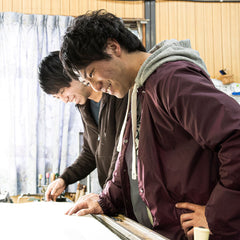
The atelier "AME Kita-Kamakura"
The Landscape That Fits in Two Hands
The series that became the foundation of AME is called HANAYAMA — "flower mountain." Small, multicolored flowers arranged into a dense, organic mass that reads as a single living thing: a meadow, a hillside, a terrain with no name. The scale is intimate. The effect is disproportionate.
In 2019, Kamei exhibited HANAYAMA — in fresh flowers — at an exhibition in Amsterdam.
"Watching people respond to it in real time was genuinely moving. Their reactions reached me directly. It was a rare experience.
But I also saw the limitation clearly: fresh flowers cannot cross the ocean. Even when someone holds the work in their hands, it will not last. If I want to share this world with more people, preserved flowers are the answer."
— Norihiko Kamei
From that realization came the preserved-flower series — and the KESHIKIFU line, in which volcanic pumice stones from Sakurajima, Kagoshima are planted with dried and preserved botanicals, each paired with a fragrance blended by a perfumer to match the landscape it carries.

Hanayama — preserved flower

Keshikifu
"Shrinking" — Making the Large Small
The concept at the center of Kamei's practice is one he traces back to Japanese aesthetics broadly: the idea of compression — of making something vast into something that fits in a room, a hand, a glance.
"The idea of building a garden inside a house is the most obvious example. You take an enormous natural landscape and condense it — bring it into daily life in miniature. The same logic runs through wagashi, through folding fans. Japan has always had this culture of binding, wrapping, folding. I am drawn to the same impulse."
— Norihiko Kamei
But compression, he is quick to add, is not the same as reduction.
"The imagination is free. A small thing can be launched outward in the mind — expanded, extended. What fits in the hand can become something vast inside the person looking at it. That expandability is part of what I want the work to carry."
— Norihiko Kamei
The Hand That Makes It
Those who have watched Kamei work describe something close to a meditative performance: tweezers moving with absolute economy, flowers placed one by one into a surface no larger than a bowl, a landscape building itself in silence.
"I think that comes from the tea ceremony — its choreography is in my body without my thinking about it. And from years of painting and making three-dimensional work. When I'm placing flowers, I'm looking at the whole from above — like a bird — painting a landscape into the surface."
— Norihiko Kamei
The response he has received from audiences outside Japan has consistently surprised him.
"At exhibitions, when people watch the process in front of them, the reaction is: I cannot believe it. I could never do that. They talk about a Japanese sensitivity — a delicacy, a depth — that is different from what they know. Others say it feels meditative. Or spiritually elevated."
— Norihiko Kamei

Flowers sorted before arrangement
A Garden for a Time of Staying Still
The UKIISHI series — in which preserved moss and leaves are arranged on volcanic stone around a concealed glass bud vase — came from a specific moment: the period during which people everywhere found themselves at home, and began to reach for plants, for flowers, for something living and quiet nearby.
"I thought: what if the work could be something people add to, not just look at? Something they complete themselves. That's when the idea of the hidden vase appeared — a place to put a single stem picked up on a walk."
— Norihiko Kamei
Moss is, alongside flowers, one of Kamei's deepest materials. Its green holds for years. The landscape it builds does not announce itself. It is simply there, on a desk or a shelf, waiting to be noticed.

Ukiishi

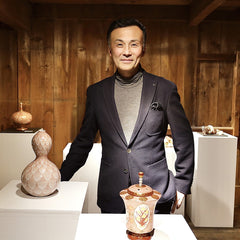
Norihiko Kamei
AME is an art product brand by visual artist and ikebana master Norihiko Kamei. Built on the concept of placing natural landscapes in the palm of your hand, AME creates small-scale works in which flowers, moss, stone, and scent are composed into scenes that exist nowhere — except in the object itself. Kamei graduated from Tokyo Zokei University Graduate School in 2007, holds a teaching certification in the Sogetsu school of ikebana, and has exhibited in the Netherlands, France, and Germany. In July 2020, he opened his atelier in Kita-Kamakura.

Find products here
AME
View Collection →