Hiroshi Taruta — Reticulated Porcelain (Hotarute) Artist from Aichi
Light Through the Wall
There is a point in the making of a hotarute vessel where the potter has gone too far to turn back. The porcelain wall has been carved through — line by line, the body opened up — and what remains is fragile in a way that cannot be undone. Any mistake from here will crack it. Any miscalculation in the kiln will finish it.
This is the condition Hiroshi Taruta works in every day, by choice.

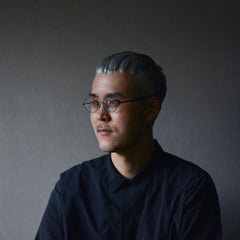
Hiroshi Taruta
The Technique
Hotarute — light held in porcelain
Hotarute is a porcelain technique with roots in Ming Dynasty China. The potter throws a vessel on the wheel, then carves openings into the unfired body — removing material until the wall is pierced through. Transparent glaze is applied to fill these openings; when fired, the glaze pools and sets, and the finished piece transmits light where the clay has been removed. The effect, in the dark, resembles fireflies suspended in the wall.
Lines, not circles
Most hotarute work uses round perforations. Taruta uses lines. The openings are larger, the structural risk is greater, and the margin for error at every stage — shaping, drying, firing — narrows accordingly. He chose this not despite the difficulty, but because of what it makes possible.
"The light that comes through the lines — it's like light breaking through clouds, or a beam cutting across a dark room. That's the light I want to work with."
— Hiroshi Taruta


Works by Hiroshi Taruta
The Path
A decision made by elimination
Taruta grew up in Nagoya, Aichi Prefecture. When it came time to choose a direction in high school, he picked ceramics — by process of elimination, he admits. He liked making things with his hands. The rest followed. He enrolled in the ceramics program at Seto Pottery High School, an institution with over a century of history in the region that had shaped Japanese ceramic production.
One thing, pursued completely
After completing a two-year advanced ceramics course, Taruta apprenticed under ceramic artist Masanori Hatano in 2007. During afternoon breaks, master and apprentice would talk — and one remark stayed with him.
"There is something to be said for taking one thing as far as it will go."
— Masanori Hatano, his teacher
At the time, Taruta wanted to work across multiple materials — combining wood, metal, clay. The advice didn't land immediately. It took years before he understood what it meant.
Europe, and a reversal
In 2015, Taruta spent ten months traveling through Europe — visiting pottery schools in southern Germany, meeting ceramic artists in the north, observing work in Sweden. His hotarute pieces, which people in Japan sometimes described as having a "European quality," were received there as distinctly Japanese. The reversal clarified something.
"If I take hotarute as far as it can go, it becomes something no one else has made. That was when I knew."
— Hiroshi Taruta
The Work
Mastery as a precondition
Taruta is direct about what he is after.
"What matters is doing what only you can do — creating something from zero. To master something is to embody beauty. But mastery requires focus. There is no time to reach in every direction."
— Hiroshi Taruta
Most of his current output is tableware — vessels with functional constraints that, paradoxically, give him a framework to work within. But he is moving toward work with no such framework. Yuragi ("fluctuation"), which received the Excellence Award at the 1st Japanese Culture Grand Prix, points in this direction: a piece 15 cm tall — larger than his usual work, where size and the risk of cracking are directly proportional — fired for twenty hours and recovered whole from the kiln.
"I wanted the curves of hotarute to generate softness. The piece became something between tension and calm — light through carved lines, the blue-white of celadon glaze, a rhythm close to 1/f fluctuation."
— Hiroshi Taruta

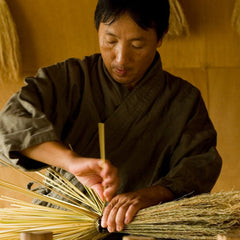
Taruta at work in his studio
When asked where he wants to end up, Taruta says he wants his work in a museum. Given the direction of the work, this does not seem far off.
Hiroshi Taruta (b. 1987, Nagoya) completed the advanced ceramics program at Aichi Prefectural Seto Technical High School and apprenticed under Masanori Hatano from 2007. He has exhibited in Japan, Malaysia, and across Europe. Awards include the Grand Prize in the Porcelain category at the 2011 Meshi-wan Grand Prix, the Grand Prize at the 65th Seto City Art Exhibition (2012), and the Excellence Award at the 1st Japanese Culture Grand Prix (2021). He works from his studio in Seto, Aichi Prefecture.

Find products here
Hiroshi Taruta
View Collection →