
Hand-crafted in Kagawa Prefecture on the island of Shikoku, Sanuki Kagari Temari are textile spheres that carry a tradition reaching back to the Edo period. There are around fifteen temari-producing regions across Japan — each with its own materials and techniques. What sets Sanuki Kagari Temari apart is the depth of its material choices, and the density of craft within each single sphere.
What Is Sanuki Kagari Temari?
Sanuki Kagari Temari are hand-stitched textile spheres originating in Kagawa Prefecture — historically known as the province of Sanuki. During the Edo period, Sanuki was renowned for three products: sugar, salt, and cotton. These were collectively called the "Three Whites of Sanuki." It is this regional cotton tradition that forms the material foundation of Sanuki Kagari Temari.

Cotton threads dyed with plants and trees are wound over a core of rice husks, then stitched with a technique specific to the Sanuki region — called kagari. The result is a sphere unlike those produced elsewhere: quieter in tone, denser in feel, and grounded in a set of material principles that trace directly back to the land.
These temari were originally crafted by the everyday hands of Sanuki women — not court objects, but folk objects. That origin shapes everything about them.
What Makes Sanuki Kagari Temari Different
Japan's major temari traditions — Kaga Temari from Kanazawa, Honjo Goten-mari from Akita — each reflect their own regional character. Sanuki Kagari Temari stands apart not in visual flair, but in the consistency of its material principles.
01 Rice husk core Rice husks wrapped in thin paper, shaped into a perfect sphere by hand — no measuring instruments. Invisible from outside, but felt in the weight and density of the finished object.
02 Cotton thread Where Kaga Temari uses silk for its lustrous sheen, Sanuki uses cotton — matte, soft, and rooted in the region's Edo-period cotton industry. The quiet texture is a deliberate choice, not a limitation.
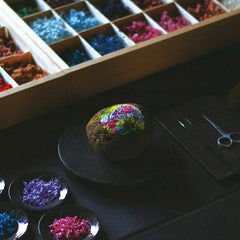
03 Plant-based dyes Madder, indigo, kariyasu, sappanwood, chestnut, onion — and combinations layered over one another. Over 120 thread colors are produced. Colors shift depending on the light.
04 The kagari technique The sphere is divided into sections — North Pole, South Pole, equator — using guide threads. Patterns are built by passing thread from line to line, within the structural constraints of the kagari method. Five years to learn the basics. Over ten to master.

Where other traditions lean toward brilliance and celebratory color, Sanuki Kagari Temari is built on restraint: matte cotton over glossy silk, plant color over chemical dye, rice husks over foam. The materials are consistent with one another — and consistent with the land they come from.
Sanuki Kagari Temari Preservation Association
The Sanuki Kagari Temari Preservation Association was founded in 1983 by Kazuo Araki, a Kagawa prefectural government official, who discovered the nearly-extinct Sanuki cotton temari tradition through his work in folk craft revival. Working with contacts at the Matsumoto Folk Art Museum in Nagano, he sought instruction in the kagari technique and secured plant-dyed cotton thread through a dyeing research institute in Ehime Prefecture — gradually breathing new life into methods that had nearly disappeared. Four years later, in 1987, Sanuki Kagari Temari received official designation as a traditional craft of Kagawa Prefecture.

The current representative, Eiko Araki, came to temari as a metal engraver. She began assisting her mother-in-law with the craft, found herself drawn deeper into it, and at forty left engraving entirely. She has led the Society since, with around 150 members continuing the work. Under her direction, the Society has shifted its focus from preservation alone toward active transmission — running professional training courses and beginner workshops, keeping the craft alive rather than merely documented.

She says the following.
"The world of temari is deep, but I think it is better to have a wide entrance. I don't only want to preserve — I want young people to see temari as something fresh and alive."
Explore Our Sanuki Kagari Temari Collection
Each piece is made by the artisans of the Sanuki Kagari Temari Preservation Society — plant-dyed cotton thread, rice husk core, hand-stitched. Three ways to bring them into your life.
Handmade Temari

Each sphere is a one-of-a-kind work selected by master craftswoman Eiko Araki. Patterns range from 92-cross flower to chrysanthemum variations — no two are alike. Small enough to hold in one hand, yet the vivid patterns — so intricate they are hard to believe were made by hand — bring a striking accent to any room. The cotton thread gives them a distinctive softness that blends naturally into everyday spaces. Currently available in five designs. Perfect for display and collecting, they are also traditionally given in Japan as gifts to celebrate a girl's growth and milestones. Now available in five designs.
Diameter: approx. 3.0 in (76 mm) · Circumference: approx. 9.4 in (240 mm)
Box: 3.4 × 3.4 × 3.4 in (86 × 86 × 86 mm)
Scented Small Embroidery Temari Box

Nine scented temari in a single box, like a collection of small treasures. Each sphere is made with plant-dyed cotton thread, stitched with kagari patterns and a touch of gold thread — no two with the same expression. The core holds natural fragrance ingredients alongside the rice husks, with a scent that lasts over a year. The fragrance is a special blend by Yamadamatsu, a long-established Kyoto incense house, using sandalwood, clove, cinnamon, and other traditional ingredients. Display them in an entryway or room, or tuck them into a drawer to let the scent transfer gently to clothing. A thoughtful gift for someone special.
Box size: 8.4 × 8.4 × 3.5 cm (3.3 × 3.3 × 1.4 in)
Scented Small Color Gradation Temari Box

A set of small temari, each color carrying its own distinct scent. Display them in an entryway or room, tuck them into a drawer — a piece that can be enjoyed for both its color and fragrance. Their compact size makes them an ideal small gift. Available in six colors.
Box size: 7.5 × 7.5 × 4 cm (2.9 × 2.9 × 1.6 in)