Sanuki Kagari Temari — Hand-Sewn Textile Spheres from Kagawa, Japan
A Ball That Takes Ten Years to Master
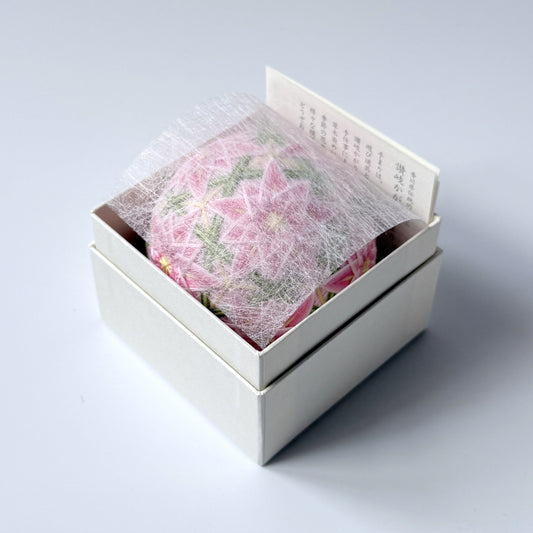
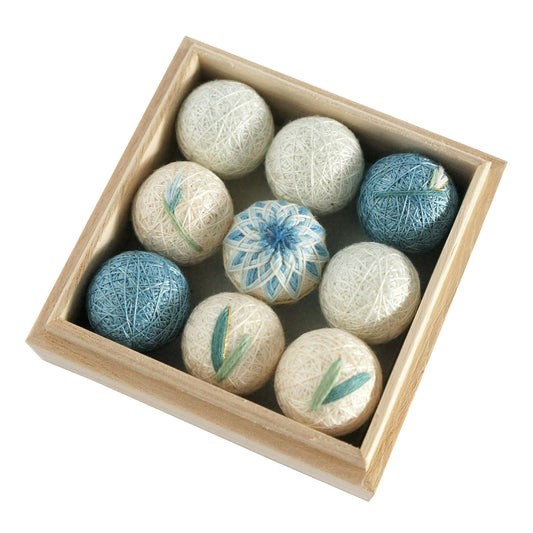
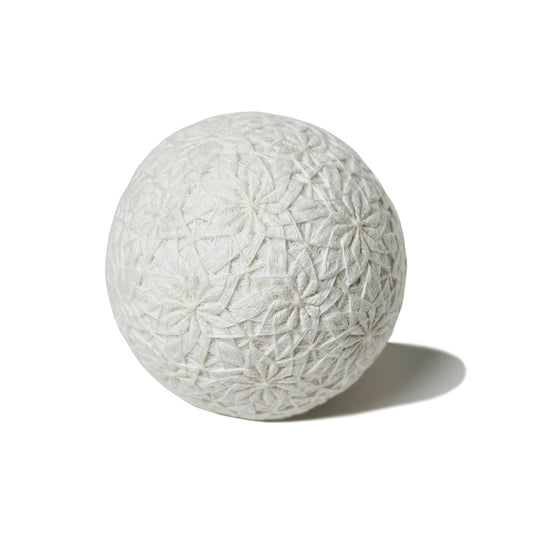
Sanuki Kagari Temari are hand-sewn textile spheres made in Kagawa Prefecture, on the island of Shikoku. Cotton threads dyed with plants and trees are wound and stitched over a core of rice husks — following a technique that has been practiced in this region since the Edo period, when Kagawa, then known as Sanuki, was one of Japan's principal cotton-producing areas.
The craft nearly disappeared. It has been brought back — quietly, systematically, and with considerable patience — by Eiko Araki, representative of the Sanuki Kagari Temari Preservation Society.

Eiko Araki
How Araki Found Temari
Araki spent her twenties and thirties as a metal engraver. Her encounter with temari came through a local researcher's collection of Japanese folk crafts and daily-life objects — a space she began visiting repeatedly, drawn to its quiet accumulation of handmade things.
"It was the first time I had seen temari. I still remember how it felt — the colorful, gentle threads laid out and stitched into a pattern. I thought it was wonderful."
— Eiko Araki
She began making temari alongside her engraving work. At forty, she stopped engraving entirely.
"The more I tried, the more I was drawn in by the depth of it. I kept thinking: how could I make something more beautiful, more pleasing to hold?"
— Eiko Araki
What Goes Into Each One
Cotton thread from Kagawa
During the Edo period, Sanuki was known for three products: sugar, salt, and cotton. The cotton thread used in Sanuki Kagari Temari is sourced from this regional tradition — a soft, matte yarn that produces the distinctive quiet texture of the finished sphere. As local cotton mills have closed over the decades, the Preservation Society has searched across Japan to maintain a reliable supply of the specific thread the technique requires.
Plant-based dyes
The threads are dyed using plants and trees: madder, indigo, kariyasu, sappanwood, chestnut, onion — and combinations layered over one another, such as kariyasu applied over an indigo base. Each dyeing material produces a distinct quality of color: some warm, some cool, some that shift depending on the light.
"The dyed threads are hung out to dry in the garden. I love that time — looking at them while I work."
— Eiko Araki

Plant-dyed threads drying in the garden
A core of rice husks
The sphere begins with rice husks wrapped in thin paper, then wound tightly with cotton thread until a perfect sphere forms — shaped entirely by hand, without measuring instruments. Many temari produced elsewhere use styrofoam as a base. The Sanuki tradition does not. The difference is invisible from the outside, but present in the weight and feel of the finished object.
The kagari stitch
Once the sphere is formed, it is divided into sections — North Pole, South Pole, equator — using guide threads. The pattern is then built up by passing the working thread from line to line, in the kagari technique specific to this tradition. The structure of the method constrains what shapes are possible; the craft consists in finding depth of expression within those constraints.

Guide lines laid before stitching begins
Preservation and Its Opposite
The Preservation Society currently has around 120 active makers. Training begins with five years of faithful reproduction of traditional techniques before any personal expression is introduced; full mastery takes more than a decade. Araki is careful not to frame this as a museum exercise.
"The world of temari is deep, but I think it is better to have a wide entrance. I don't only want to preserve — I want young people to see temari as something fresh and alive."
— Eiko Araki
The Sanuki Kagari Temari Preservation Society was established in Kagawa Prefecture to document, teach, and continue the temari tradition of the Sanuki region. Under Eiko Araki's direction, the Society trains professional craftspeople, maintains the use of traditional cotton thread and plant-based dyes, and produces temari using methods continuous with the Edo-period practice of the region.