Kawachiya — Hand Gold-Edged Notebooks and Fine Stationery, Tokyo
A Print Shop That Became Something Else
Kawachiya was founded in 1971 in Shimbashi, Tokyo, one block from the advertising agencies, newspaper publishers, and high-end retailers that made the area a center of Japan's postwar print industry. For decades, the company built its reputation on one principle: however demanding the client, the quality would not move.
"Even when requests were unreasonable, we had to ensure quality without exception. Through that process, our craftsmen's skills were refined, and we accumulated the kind of know-how that lets you respond to anything."
— Ryosuke Kunisawa, President

Mother plates for letterpress printing
When print media began its decline in the 2000s, Kawachiya faced the same question every specialist print shop faced: what to do with skills that the market no longer needed at the same volume. Kunisawa's answer was to turn those skills toward something entirely their own.
"The special printing techniques we had built up over years — they were our assets. If we could apply them to our own expressions, we could make something new and unprecedented. I was convinced of that."
— Ryosuke Kunisawa

Ink archive at the Kawachiya workshop
The Technique: Tenkin
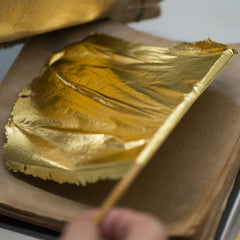
Gold applied to the edge, by hand
Tenkin is a finishing technique in which gold foil is applied to the cut edges of a notebook or book block. Only two print shops in Japan have preserved the knowledge to do it at all. Kawachiya is the only one that applies the foil entirely by hand.
When Kawachiya's original brand made its debut at a major stationery exhibition in 2017, the tenkin process drew a crowd. The notebooks — printed on Paspier paper, a stock with a silky surface and strong ink absorption — and finished with hand-applied gold edges were unlike anything else at the show. The response led to commissions from luxury brands and, eventually, from foreign royal households.

Tenkin — hand-applied gold edge finishing
"By pursuing what we believed to be authentic without compromise, we found that people responded. That was the moment I understood: uncompromising work does get through."
— Ryosuke Kunisawa

Kawachiya original stationery
The Morris Series
A Victorian pattern, rebuilt in resin and gold
William Morris spent his career pushing printing toward its technical limits — experimenting with every method available in 19th-century England, from letterpress to silkscreen. The question Kawachiya asked was simple: what happens when his patterns are interpreted through techniques he never had access to?
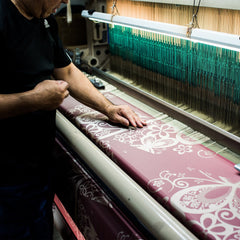
The Morris series is produced by coating paper with resin, then exposing it to ultraviolet light to generate controlled surface shrinkage. Gold foil is then applied over the resulting texture. Where the surface is raised, the foil catches light directly. Where it recedes, the gold deepens. The effect cannot be produced by printing or embossing alone — it is a product of the specific sequence of processes Kawachiya has developed.

The Morris series — UV resin and gold foil on Paspier paper
"Morris took printing to the extreme. His spirit — though I say this with some presumption — is something I see in what we do here. I want to continue making things that reach people in some quiet, precise way."
— Ryosuke Kunisawa
Kawachiya was founded in 1971 in Shimbashi, Tokyo. The company began as a letterpress printer during Japan's postwar industrial expansion and developed expertise across offset, specialty, and surface finishing techniques over five decades of client work. Its original stationery brand, launched in 2010, applies these techniques — including the hand tenkin gold-edge process — to notebooks and paper goods produced in small quantities at the Shimbashi workshop.

Find products here
Kawachiya
View Collection →