Hagi Ware Artist in Nagato, Yamaguchi, Japan
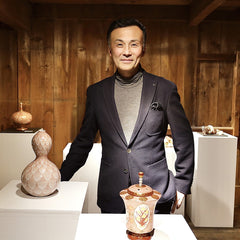
Zenemon Sakakura is a Hagi ware (Hagiyaki) potter working in Nagato City, Yamaguchi Prefecture — the region where this pottery has been made since the Edo period. He relighted his family's kiln after it had stood cold since his grandfather's generation, and works today in both sculptural ceramics and tableware for daily use.
What Sakakura makes from that inheritance looks nothing like what most people expect of Hagi ware — and that, he would argue, is what inheriting it actually requires.
"Tradition is said to be something that lives and flows. To imitate old techniques and pass them on unchanged — that is simply handing things down. To create something that will last a hundred years, you must do what is right for the current era."
— Zenemon Sakakura
What Hagi Ware Is
Hagiyaki is a ceramic tradition of Yamaguchi Prefecture, long valued by tea practitioners for its undecorated, softly textured surface. The clay body is slightly porous. As a piece is used over months and years, fine crazing develops in the glaze — and tea, sake, or water seeps gradually into these fissures, shifting the color from within. No two pieces age in the same way. The object that comes out of the kiln is not yet finished; it finishes itself in the hands of whoever uses it.

Hagiyaki bowl
Ceramic Art and Tableware by Zenemon Sakakura
Sculpture from the sea
Among Sakakura's best-known works are ceramic fish — anatomically precise, surface-detailed, built in a style entirely at odds with Hagiyaki's rustic reputation. The idea came from somewhere straightforward.
"I liked fish. Nagato is near the sea and the fish here is delicious. I wanted to preserve the form of fish in three dimensions — the way a gyotaku fish print preserves the impression of a catch."
— Zenemon Sakakura

Flower vase with a crab

Ceramic fish — black porgy
Hagi Ware Tea Cups and Tableware
Alongside his sculptural work, Sakakura makes cups and tableware built for everyday life. For these pieces, he developed a glaze derived from the red shale of the Akama inkstone — a traditional craft material of Yamaguchi Prefecture — which produces a deep, matte black surface with the same quiet density as the inkstone itself.
He is interested in what happens when an ordinary act — drinking coffee, water, sake — is done with a cup that carries this kind of weight. Not ceremony. Just attention.
A Tradition Made to Last a Hundred Years
"I want to find as many ways as possible to express what can be made with the materials available today. If even one of these techniques survives for a hundred years — that is when a tradition becomes a legend."
— Zenemon Sakakura
Zenemon Sakakura works in Nagato City, Yamaguchi Prefecture, where Hagiyaki has been produced since the Edo period. He relighted the family kiln after it had been inactive for a generation, and continues to develop both sculptural and functional work using Hagiyaki techniques and locally sourced materials.

Find products here
Zenemon Sakakura
View Collection →