Skip to product information
1 of 1

Muto — Ultra-fine silk cashmere weaving, Nishikatsu, Yamanashi

A weaving town fed by Fuji snowmelt
Nishikatsu sits in the southeastern corner of Yamanashi Prefecture, where roughly 80% of the land is forested and the rivers run with snowmelt from Mount Fuji and Lake Yamanaka. The town has been a weaving center for centuries — its reputation built on kaiki, a fine silk fabric woven there since the Edo period and used as kimono lining across Japan. muto was founded here in 1967, and has remained here since.

Nishikatsu, Yamanashi — fed by snowmelt from Mount Fuji

Nishikatsu, Yamanashi — fed by snowmelt from Mount Fuji

The moment that changed the company's direction
muto's first business was yaguza-zabu — bedding sets including mattress covers, pillowcases, and cushions — woven from kaiki silk and sold as wedding trousseau items. For a generation, this worked. Then the custom faded, and with it the business model. Hidetaka Muto, the current representative's father, began visiting department stores across Japan looking for what might come next.

What he found was a Loro Piana cashmere stole.

"When he picked it up for the first time, he was overwhelmed by the softness and the feel of it. He knew immediately — this is it."
— Nobuaki Muto, muto

Loro Piana's stoles were — and remain — among the most regarded in the industry. Hidetaka bought one, brought it back to the workshop, and began asking a different question: not how to copy it, but how to surpass it. The project that followed took years and confronted him with considerable technical difficulty. In 1993, the first muto ultra-fine silk cashmere stole was completed.

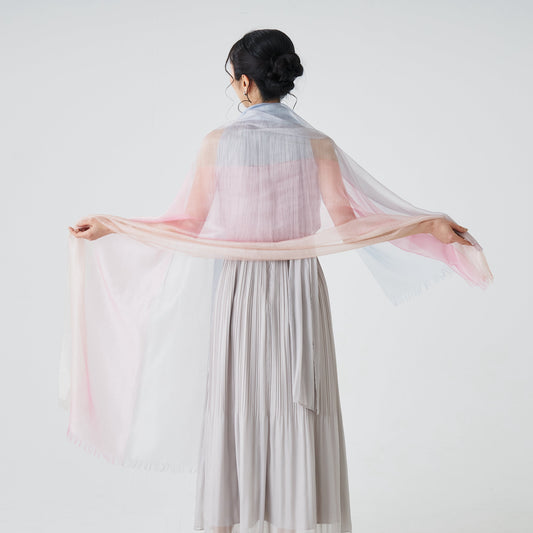
muto's ultra-fine silk cashmere stole

muto's ultra-fine silk cashmere stole

muto's ultra-fine silk cashmere stole

Première Vision, Paris — and a decision made
muto's stoles grew in reputation through the 1990s and 2000s, reaching customers in Japan and beyond. An invitation came to exhibit at Première Vision in Paris — the world's leading textile trade fair, where only companies with exceptional production quality are given space in the curated section for outstanding makers.

"Seeing the reaction of people from the world's top fashion houses in person — that was when I thought: this is interesting, there's real possibility here. And that's when I decided to join the family business."
— Nobuaki Muto, muto

Nobuaki was a third-year university student when he attended that exhibition. Shortly after, his older brother Keisuke — who had been working in architecture — made the same decision. Both joined around the same time, and both started from the beginning: learning how to maintain the looms, then how to operate them, then how to work with the ultra-fine thread that defines the company's output.

"A single silk stole takes at least six months to complete"
The preparation alone — before a single stole is woven — takes approximately six months. The ultra-fine thread is co-developed with a spinning company and produced abroad to muto's specifications. It is then double-covered: a process in which the thread is wound with a secondary fibre to increase its tensile strength, because at this fineness, the bare thread cannot withstand the mechanical tension of the loom without breaking.

"muto's finest thread is about one-third the diameter of a human hair. It's extremely fine and delicate. In its bare state, it cannot be woven. That's why the double covering is so essential."
— Nobuaki Muto, muto

After double covering, the warp threads are prepared — counted, aligned, and set to the correct length for the batch — and then drawn through the heddles of the loom one by one before weaving can begin. Once on the loom, the thread's fineness limits production to approximately four stoles per day.

Maintaining the loom — muto workshop

Maintaining the loom

Preparing the warp threads

Preparing the warp threads

Joining finished warp threads to new ones — one thread at a time

Joining finished warp threads to new ones — one thread at a time

Finished in Fuji snowmelt water
The final step is finishing: the woven cloth is passed through the subterranean water that flows beneath the Fuji foothills — a soft water with very low mineral content. This process gives the fabric its characteristic luster and depth, qualities that cannot be achieved through dyeing or coating alone. The water that runs through Nishikatsu is, in a meaningful sense, part of what makes a muto stole a muto stole.

Finishing the cloth in Fuji subterranean water

Finishing in Fuji subterranean water — luster and depth emerge from the soft mineral-free water

What comes next
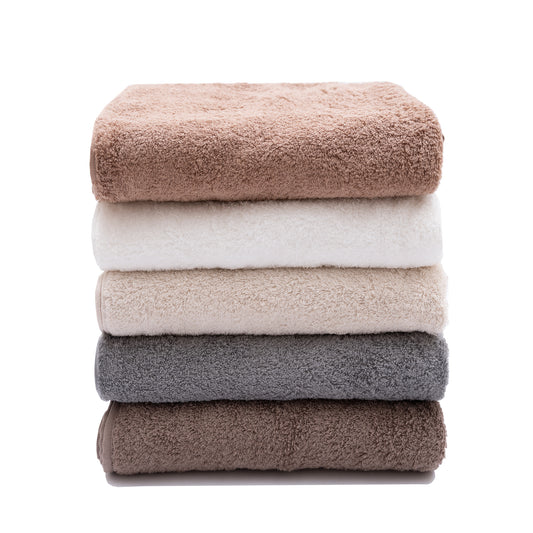
The brothers continue to look for where muto's techniques can go. During the period of reduced movement brought on by COVID-19, they developed a high-absorbency towel using specially processed thread — a new category, made possible by the same material knowledge that underlies the stoles. Further expansion into clothing and accessories is underway, with the aim of building a brand that can propose a coherent way of living through textiles.

"Day to day there's always something. But when I need to ask Keisuke for something, I can say five things and ten are understood — that's the good part. (Laughs.) We clash too. But we both trust that the other is trying to make the company better. That trust is what gets us through."
— Nobuaki Muto, muto

Nobuaki Muto and Keisuke Muto — muto

Nobuaki Muto (left) and Keisuke Muto (right)

muto's story is still being written — warp and weft, thread by thread.

View full details

Items